Wildlife Photo Diaries 2026
October 2026
September 2026
A few Insects and a surprise in the kitchen!
A Hornet was a welcome visitor (19th), the first one this year. It landed on the Clematis (which Common Wasps having been spending time on; presumably collecting plant material for their nest) briefly, before flying off.
A Small White was seen again (20th) and birds in the garden included: 3 Blue Tit, 2 immature Blackbird, 4 Wood Pigeon, 2 Collared Dove, approximately 6 House Sparrow, Robin, Dunnock and 2 Starling.
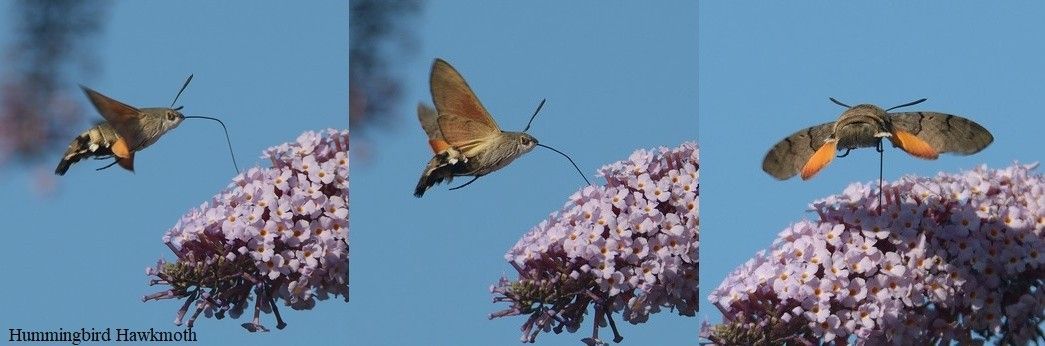
A male Common Darter was in the garden (21st) one of very few Odonata visits this year. 2 Goldfinch visited, whilst a Sparrowhawk was overhead with a small flock of Starling close by and 2 possible Skylarks (saw them very briefly) flew over. A Hummingbird Hawkmoth visited the ever-diminishing Buddleia flowers in the late afternoon/early evening.
A Brown Rat had somehow got into the kitchen (28th) and when I approached it ran behind the fried-freezer. However, despite ‘poking about’ in the freezer compartment, I couldn’t find the rat, so I turned the fridge-freezer’ s back towards the back door, which I had opened and hoped the rat would go back outside.
September Garden Diary; 1st-18th
2 Large White represented the Butterfly component in the garden (1st), after a poor year yet again for butterflies, barring the Painted Lady invasion. Of note bird-wise was Robin, immature Blackbird, 3 Blue Tit, Dunnock and a few House Sparrows.
Finally, a good amount of rainfall (2nd), but nothing to touch months of drought and the soil remains very dry. It’s almost like an African year in the UK now with a wet and a dry season; perhaps that is where we are heading with nothing of any significance done to avert climate change!
A Hummingbird Hawkmoth was visiting the Hot-lips flowers (3rd), a very fresh-looking individual. 2 Small White and a Red Admiral were also seen.
Both a single Large and Small White were present (5th).
A Hummingbird Hawkmoth spent a few moments visiting the Hot-lips flowers (6th) and a Small White was seen earlier in the day.
A single Small White was again in the garden (7th) and 3 Blue Tits, Dunnock, Robin and an immature Blackbird were also seen.
A Large White was seen (10th).
A Painted Lady was seen on one of the remaining Buddleia flowers (12th). A small White was also present as was a juvenile Common Green Shieldbug on the Aquilegia leaves, both Carder and Buff-tailed Bumblebee queens, 1st instar Large White caterpillars on the Nasturtium leaves and a House Martin was overhead.
A Small Tortoiseshell flew quickly through the garden (14th) and a Small White also present. A footballer Hoverfly Helophilus pendulus was seen along with a Buff-tailed Bumblebee. Some unwanted corned beef was put out in one of the feeder trays and attracted Common Wasps (not the intended birds), which were carrying pieces away.
A Magpie was drawn to the remaining corned beef and the first Pink-footed Geese of the autumn were heard (15th).
A Small White, was again present 16th).
A Muntjac was seen running off out the front of the premises (17th) and a Small White was seen (18th).
August 2026
A rather quiet August in the garden......
Both Large and Small White and a Silver Y were of note (14th). A ‘Batman’ hoverfly Myathropa florea was seen, as was a Robin and a Swallow flew over. Red-tailed and Buff-tailed Bumblebees were present and a Red-legged Shieldbug Pentatoma rufipes was found. A Hummingbird Hawkmoth was visiting the Hot-lips flowers and Hedgehog sightings were at 21.20 and again ten minutes later.
A Brown Rat was seen drinking at one of the water bowls (15th).
A Wren was in the garden (16th) along with Robin, Blue Tit and Dunnock.
A Red Admiral and a Large White were seen (18th) and the following day (19th) there were 2 Small White and a Wren.
A juvenile Brown Rat was seen on the bird bath and climbing up the fork handle (20th). Both a Large and Small White were more welcome visitors.
A Small White was seen on both 21st and 22nd and there was still one (23rd) when there was also a Large White and the first Common Darter of the garden year.
A Hummingbird Hawkmoth visited the Hot-lips flowers (24th).
A Small White and a Brown Rat were seen (25th), as were 3 Blue Tits; maybe the same 3 juveniles which visited the garden previously but now in more adult plumage.
The 3 Blue Tits were seen again (26th), as was ta Brown Rat! A Red Admiral was at the front of the dwelling and a Hedgehog was seen moving over the back grass, just beyond the garden gate.
A Bat sp. flew past the outside of the garden (27th) and looked to be a medium-sized bat and not a Pipistrelle. A Hedgehog curiously walked past in the same place as the previous evening and one was seen in the border at 21.20.
2 Immature Blackbirds were in the garden searching for food (28th) and one was still present the following day (29th) when there was also a Small White.
A Peacock was seen (30th), along with 2 Large Whites.
3 Blue Tits were once again in the garden (31st), nearly always within a short distance of one another. A Hedgehog was recorded at 21.00 and again a few minutes later.
A Norfolk day out in the drought!
A day out with Jason Nichols (13th) was not so much about what we saw, but what we didn’t! Once again, a very hot day and even the insects were hiding!
We began the Norfolk coast trip at Salthouse, where we found 40+ Curlews looking for food on the fields. Cley Beach Road was pretty much devoid of life, with no water in the pool on the Eye Field, not surprisingly and it was clear that this long drought was affecting the wildlife.
We decided not to look at Morston Quay; the holiday season what it is we decided not to join the crowds. Nevertheless, we did visit Wells Pools, but again everywhere was very dry. However, a Clouded Yellow flew past and disappeared around the side of a campervan parked there.
Brancaster Staithe for lunch, but not many birds, but we did see 8+ Ringed Plover and a Little Egret and a drive around Choosley Barns found very little except for a Red Kite.
We headed back along the coast, stopping at Holkham, but again very little here, but there was an area of water.
We stopped at Cley and went to Bishop’s Hide, where the unseasonal Jack Snipe was shown to us from a birdwatcher’s scope, but it didn’t come out from the reed island, so no photographs. 2 Little Ringed Plover, 3 Black-tailed Godwit, Avocet, 7+Ruff, several Dunlin and a Spoonbill were the highlights here.
Med Gulls fly in to feed on flying ants and return of the Rat!
A single Large White was in the garden at the beginning of the month (1st). Apart from the Painted Lady invasion earlier in the year butterflies, once again have been very scarce and Ken Saul tells me Moth numbers have been down thus far this year.
House Sparrows, Starlings, Goldfinch, Wood Pigeon, 2 Collared Dove and 2 juvenile Blue Tit were of note.
Large White and Red Admiral were present (2nd) and 3 Swift were still present.
A Small White was looking for suitable plants, on which to oviposit (3rd) and there was a visit from a Hummingbird Hawkmoth. At least 3 Silver Y were in the garden in the evening and a Hedgehog was seen around 22.00.
A Painted Lady, Large White and a Holly Blue were seen (5th) and both a juvenile Robin and Blue Tit were present. The garden has provided a good place to stay, over a long period of time for juvenile Robins this year, although none bred in the garden. Later at least 80 Mediterranean Gulls were in the skies, no doubt feeding on flying ants. Also in the skies were 3 Swift and 5 House Martin.
2 Small White were seen (7th) and a Hedgehog was seen at 22.20.
2 Small White remained in the garden (9th), with just one seen the previous day. A Holly Blue visited a Garlic Chive flower, something which I was familiar with when I lived at Forncett St. Peter in the late 90’s and early 2000 and a Bee-wolf was seen. A Painted Lady was on one of the remaining Buddleia flowers and 2 Hummingbird Hawkmoths visited the Hot Lips flowers. The first Migrant Hawkers of the year were seen with 2 flying over the garden. There were more Mediterranean Gulls in the skies, with an estimated 150 present; filling the skies above the garden! Not as welcome as other garden visitors, although I do admire their intelligence and adaptability; a Brown Rat visited the garden, probably the first of more visits!
A Large and Small White were seen (10th) and a Brown Rat was seen again.
Artificial Grass; a great place for Rats to live?
For the second time this year, Brown Rats are coming into the garden from next door’s garden which is covered with artificial grass, laid over shingle; providing (as stated online) as the ‘ultimate Rat highway’! Unless this ‘plastic carpet’ is completely sealed at the edges (which this isn’t!) Rats have the perfect place to make runs and nest.
When I put information into Google, saying plastic grass had been laid over shingle, the following was stated: ‘Your neighbour has accidentally built the ultimate rat highway. Laying plastic grass directly over loose shingle with no proper excavation or compacted sub-base creates thousands of shifting, hollow voids. To a rat, that loose shingle is incredibly easy to tunnel through, and the plastic grass acts as a warm, weatherproof roof that protects them from predators like owls and cats.
Add to this that artificial grass also does not let pet urine drain away effectively, causing bacterial problems and disease for pets, you would wonder why people choose this covering for their ‘gardens’ and although one of the reasons is that, apparently there is no maintenance. However, if this artificial surface is laid properly, so Rats can’t utilise it, there is one hell of a lot of work with making a firm base and sealing all the edges. So why not create a meadow and cut it just once a year, providing a home for wildlife and very minimal maintenance?
I found the only people giving this artificial grass any credence was those that supplied this stuff.
Although, I as an ecologist could seem somewhat biased in my disgust for this product (I mean, just what we want more plastic in the world-hardly recyclable!), the facts speak for themselves. Furthermore, if someone can’t manage a garden as a garden, don’t buy a house with one! There are many people who would love to have a garden, especially those who live in rented properties, such as here, so people who don’t like the natural world on their doorstep should go and live in a high-rise flat, then they would have very low maintenance indeed!
A Brown Rat was seen again (11th), coming in for meagre offerings on the ground from the feeding station, which has now been curtailed, but mainly for water. A sad sight was a male Blackbird with its feet missing on its right leg; just a ‘stilt’ remaining. 2 Hummingbird Hawkmoths were once again feeding on the Hot lips flowers and whilst clearing out the bedroom, which has become somewhat of a storage room, I found a dead Elephant Hawkmoth. A new record, but shame it was dead and how long it had been there is not clear.
A Small White was of note (12th) and as usual now a Brown Rat!
July 2026
Hummingbird Hawks and Hedgehogs
The first Leafcutter of the year (15th) was a Patchwork Leafcutter Bee Megachile centuncularis going into the bee hotel. A Gwynne’s Mining Bee was also present. 2 Small White and a Painted Lady were present and a House Mouse was in the border, no doubt feeding on the spilt seed. 2 Swift were in the skies.
The House Mouse was seen in the border again (16th). A Painted Lady was the only butterfly seen and a Gwynne’s Mining Bee was visiting the Scabious and Marjoram flowers. 2 Swift were initially overhead with 8 seen later.
A female Yellow-legged Mining Bee and 4 female Gwynne’s Mining Bees were present (17th) and a Patchwork Leafcutter at the bee hotel. Gatekeeper, Small and Large White were in the garden and birds included: both adult and juvenile Robins, with one heard singing outside the garden, House Sparrows, Starlings, adult and juvenile Dunnock and 5+ Swift and a Swallow were in the skies.
No Swifts were seen today (18th), but a Painted Lady was in the garden along with an adult and juvenile Robin.
After their absence yesterday, a single Swift was seen (19th). Gatekeeper and Large White were present as were Gwynne’s and Yellow-legged Mining Bees, with a Hummingbird Hawkmoth paying a visit in the late afternoon.
An early morning look-out of the kitchen window (20th) saw a Hedgehog at 01.55, unfortunately with 3 white stripes painted on its body. The same hog, along with a slightly smaller hog were feeding alongside each other at 02.27 and a ‘large’ Hedgehog was seen at 03. 28.
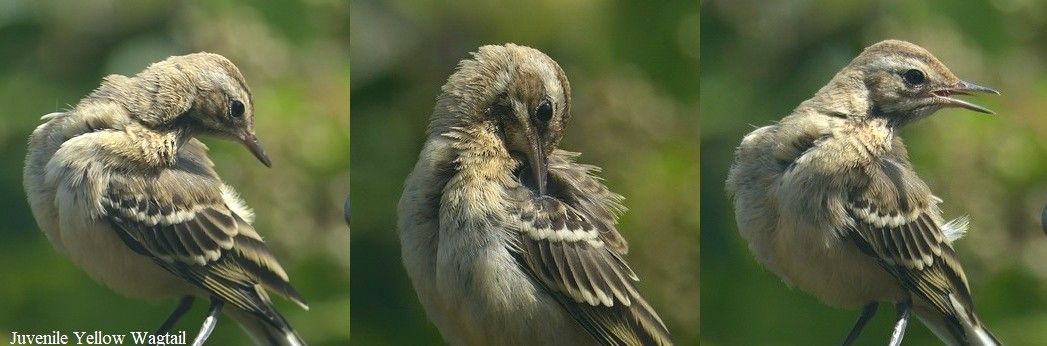
During the day, something very surprising was seen, when I looked out of the kitchen window to see a juvenile Yellow Wagtail bathing in the small ‘frog’ birdbath! I never thought I would have this wagtail in the garden; they are hard enough to see anywhere nowadays. Large White and Gatekeeper, Goldfinch, adult and juvenile Robin were all in the garden and a House Martin and 2 Swift were overhead. A Hedgehog was seen again at 21.41 feeding on cat biscuits.
2 Wrens were seen (21st), with one chasing after the other. A juvenile Robin was also in the garden.
A Hummingbird Hawkmoth was seen (22nd) and 3 juvenile Blue Tit, juvenile Robin and 3 Swift (later 9) were also seen.
A Hummingbird Hawkmoth was present again (23rd), as was a Gwynne’s Mining Bee and a juvenile Robin. 4 Swift were in the skies.
Unbelievably, the same or a different individual Yellow Wagtail was seen again (24th)! This time it was a few feet outside the lounge window, perched on the 2nd feeding station, where it spent several minutes preening.
Large and Small White, Gatekeeper, Peacock and Red Admiral were in the garden, as was a Small Purple and Gold. Birds included a Great Tit and a single Mediterranean Gul with Black-headed Gulls were presumably feeding on flying ants, overhead and at least 8 Swift were probably doing the same. A Volucella inanis Hoverfly visited the garden in the late afternoon, as did a Hummingbird Hawkmoth.
Large and Small White and 2 Swift were of note today (25th).
10+ Swift, 3 House Martin and a Hobby were in the skies (26th). A Gatekeeper visited the Marjoram flowers, a Hummingbird Hawkmoth paid a visit, once again and a Hedgehog was seen at 21.50.
A Great Tit had a bath in the small ‘hedgehog’ bowl (27th). Large White, Red Admiral and a juvenile Robin (with red now showing through on breast) were of note, while a single of both Swift and House Martin and a possible Hobby were seen.
A Hummingbird Hawkmoth made 4 different visits (28th), visiting the flowers on the Hot-lips (where it spent approximately a minute) and on the Buddleia. A Solitary Wasp species was entering the bee hotel and there were several Common Wasps around mainly coming in to drink, from the various water sources. Large White, Small White and 2 Gatekeeper were present and 2 Goldfinch came to drink from the pond. Overhead, were 3 Swift, 3 House Martin and a Cormorant flying over.
A Small White, juvenile Wood Pigeon and Wren were seen in the garden (29th), 3 Swift remained but for much longer? A Hobby flew over at speed in the early evening, when there was another visit from a Hummingbird Hawkmoth.
An adult Robin and Small White were present (30th), as were 2 Swift.
Both Large and Small White were in the garden (31st), as was a Yellow-legged Mining Bee. One Swift was seen high up and at least 15 Swallows were flying through and 2 House Martins were also in the skies. A Hummingbird Hawkmoth visited the Buddleia, whilst the sun was out, enabling a spot of photography.
Brambles
Today (1st) was a very sad day for me. My friend who shared my bungalow with me for over 8 years, had to be put to sleep. I am talking about Brambles my Rabbit. He was over 10 years old; a long life for a Rabbit, but that doesn’t make his passing any easier. I have tried, in preparation for this day, tried to tell myself he had a great life here, which he did and was loved so much but his age and a tumour in his leg, along with very brittle bones meant that he was in a lot of pain and I had to agree with my friend Sally that being put to sleep was the kindest thing to do. We had a great relationship; well, as much as a Rabbit and a Human could have and I learnt so much about rabbit behaviour during the time spent with Brambles and indeed before him; with Lucy and Benji. Brambles was a great help in the garden, consuming all sorts of vegetation I brought in for him, including pruning’s from Hawthorn and Buddleia davadii (but not Buddleia globosa!) and particularly loved Fennel. I will miss my friend very much, but Brams will never be forgotten.
In the garden, on this painful day were: Small White, Painted Lady, Peacock (on Privet flowers), Hummingbird Hawkmoth (2 separate visits), juvenile Robin, juvenile Starling, 10 House Sparrow, plus juvenile being fed by female, Collared Dove, Wood Pigeon, Blue Tit (juv and adult), Blackbird (female, male and juv), Great Tit and Dunnock.
There were, again two sightings of Hummingbird Hawkmoth (2nd). Also seen were 2 Small White Large White, Peacock, 2 different juvenile Robins, juvenile Blackbird, Dunnock, House Sparrows and Dunnock.
An interesting bit of behaviour (3rd) when a juvenile Blackbird removed a rose petal from the small birdbath before bathing! 3 juvenile Blackbirds plus a male and female were also present. 2 Juvenile Dunnock, juv House Sparrow being fed, Collared Dove, 2 Wood Pigeon, 3 adult and a juv Blue Tit and 2 Swift in the skies were of Avian note and Small White, Comma and Large White were the butterflies present. Whilst pruning the Buddleia globosa I found many holes in the Wild Rose leaves made by Leafcutter Bees. However, there has been no sightings of any Megachile Bees, so far this year.
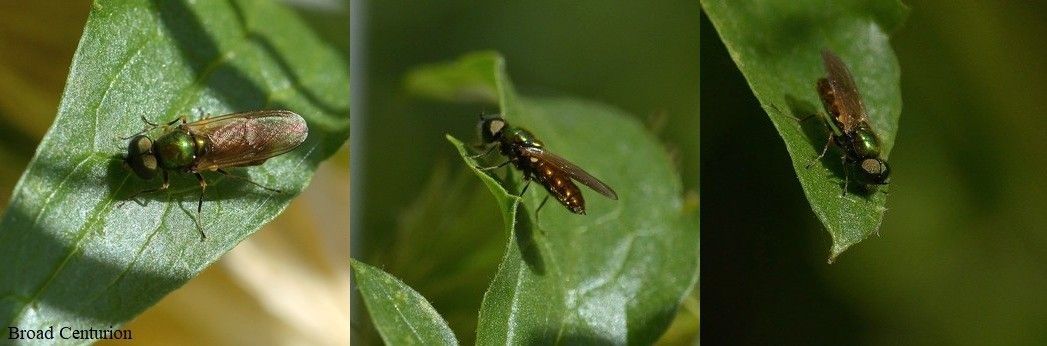
The first Gatekeeper was in the garden (4th) and Comma, Large White, 2 Small White and Red Admiral were also seen. A Hummingbird Hawkmoth paid a visit and an Aeshna Dragonfly flew through the garden and was either a Norfolk Hawker or a Brown Hawker; the former is most likely from what I saw. 2 juv Dunnock, a juv Robin (with almost complete orange breast) Goldfinch, 2 Wood Pigeon, 2 Collared Dove, House Sparrows and 3 Swift were in the skies. A very noticeable small Fly was photographed and was identified as a male Broad Centurion Chloromyia formosa.
A Hummingbird Hawkmoth was once again present (5th) and 3 Blue Tit (1 juv) and a juv Robin were also seen.
A male Emperor Dragonfly flew through the garden (6th), a new species of Odonata for the garden. Comma, 2 Large and 3 Small Whites, Peacock and Red Admiral were present as was a Hummingbird Hawkmoth at 20.40. Goldfinch, 2 different juv Robin, juv Dunnock, 2 juv Blackbird, plus a male and 3 Swifts overhead were the birds seen.
2 Peacock, 2 Small White, 2 Large White and a Red Admiral were present (7th).
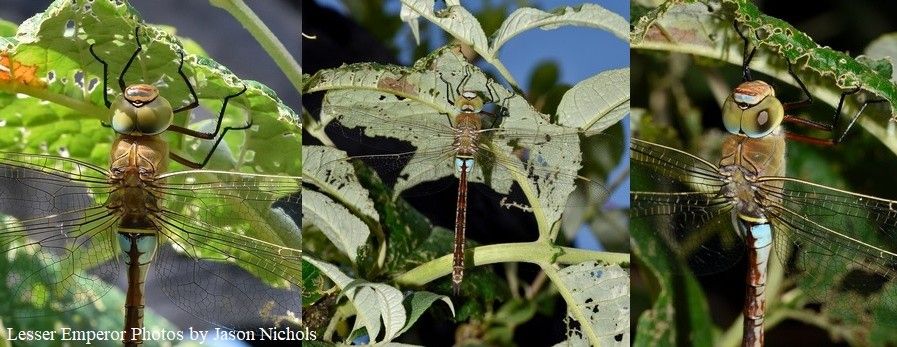
Meanwhile, at Gorleston, Jason Nichols found a Lesser Emperor, perched up in his garden. A great find and again, just shows the rewards when you garden for wildlife.
A Peacock, Large White, 2 Small White and a Red Admiral were in the garden (8th) as was a Hummingbird Hawkmoth (been a regular visitor), Juveniles of: Dunnock, Blackbird, Blue Tit and Robin were seen and an adult Great Tit and 2 Swallow flew over and at least 8 Swift were present.
Peacock, Large White, 3 Small White, Gatekeeper and a juv Robin were seen (9th).
8 Species of Butterfly today (10th), with 2 Gatekeeper, 2 Large, Green-veined and Small Whites, Red Admiral, Painted Lady, Peacock and a 2nd gen Holly Blue seen. 12+ Swift were overhead, as was a Red Kite.
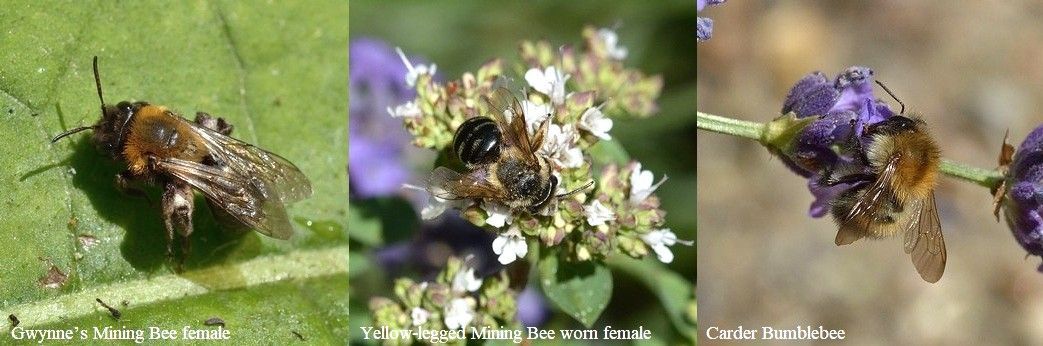
Two Andrena Bees were found; a worn female Andrena flavipes Yellow-legged Mining Bee on the Oregano flowers and a female Andrena bicolor Gwynne’s Mining Bee. A worker Carder Bumblebee was also seen.
A House Mouse was in the border (11th), a Red Kite was overhead as were 6+ Swift and juv Blackbird, juv Dunnock and juv Robin were in the garden; or should I call it the nursery!
Large White, Small White, Painted Lady, Peacock and two visits from Hummingbird Hawkmoth/s were the insect highlights (12th). 2 juv and a male Blackbird, juv Dunnock and a visit at 22.04 by a Hedgehog for a long drink and then consumed some cat biscuits were all seen in the garden.
2 Juvenile Robins were in the garden (13th), like last year there has been a juvenile Robin presence for many weeks.
A Gatekeeper, Meadow Brown, Comma, Large White and Small White were all present in the garden, as was a Silver Y, which a Robin attempted to catch (14th). There were 2 Juvenile Robins, although one was very nearly an adult. Blue Tit, Dunnock, House Sparrows, juvenile and male Blackbird, 3 Wood Pigeon and 4 Collared Dove. 3 Swift were above the garden.
June 2026
Second half of June sees Hummingbird Hawkmoth, Meadow Brown and Small White in the garden......
6 Swift were in the skies (15th) and a male Muntjac was on the grassed area behind garden at approximately 21.00.
A Hedgehog was seen at 02.30 (16th) (something to be said for keeping unorthodox hours!). A small brownish Butterfly flew through the garden (but wasn’t seen again to identify it), a Narcissus Bulb Fly was seen, along with a juvenile Robin and Blackbird and 3 Swift were overhead.
3 Swift were in the skies (17th) and an Oystercatcher was heard calling as it flew over and a Wren was repeatedly singing in the garden.
A Hummingbird Hawkmoth was present (18th), a Wren was heard singing twice in the garden and a Goldfinch paid a visit and 2 juvenile Wood Pigeons were also seen.
A Large White was seen and the first Meadow Brown was in the garden (19th). A Bee (possibly an Orange-vented Mason Bee) entered the bee hotel, a female House Sparrow was feeding a juvenile, a juvenile Robin was again present, as was a Goldfinch. A Hobby was seen at 19.55, 4+ Swift were also in the skies and a House Mouse was seen in the border. 2 Juvenile Wood Pigeons were being fed by a parent outside the garden.
A Silver Y was found in the bungalow (20th), a juvenile Robin was in the garden and 2 Summer Chafers were around the Buddleia, in the early evening.
The period between 21st and 30th June was spent in Uganda, but on my return, the first 2 Small Whites were in the garden along with a female and juvenile Blackbird.
First 2 weeks sees Hedgehogs, Hummingbird Hawk and some interesting Blackbird behaviour!
3 Painted Ladies were present (1st) and also seen were; Goldfinch (pair at pond) and a Blue Tit.
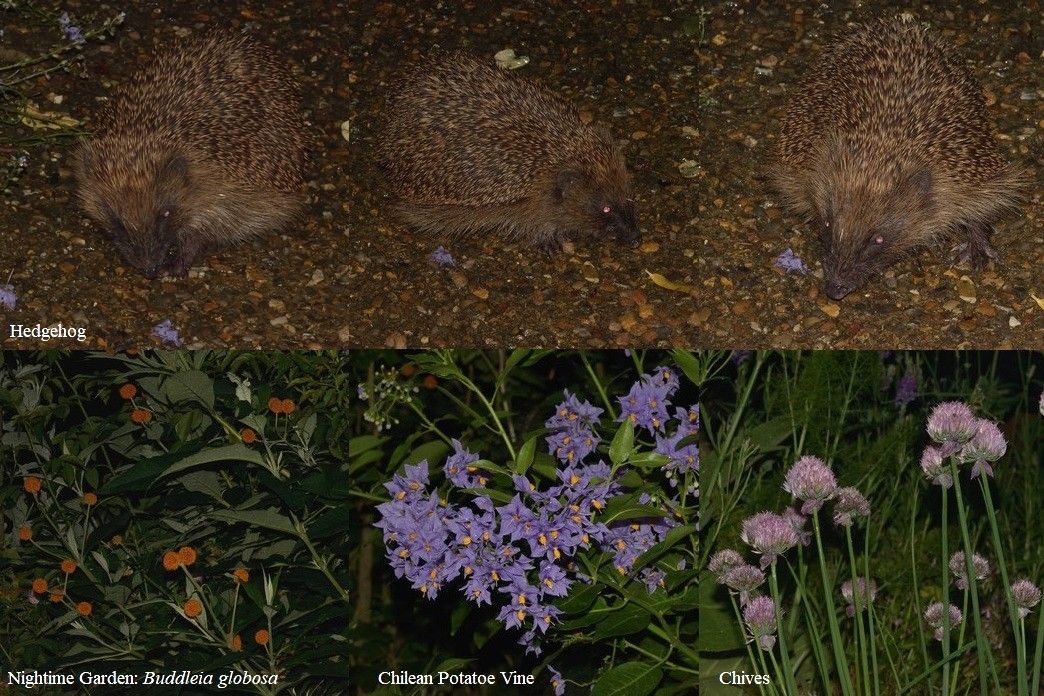
In the evening, Silver Y moths were in the garden and 2 Hedgehogs were in the garden at 21.55, before any food was put out. At 22.05 a different individual came in to feed (food had been put out) from the back border and at 22. 28 2 Hedgehogs were present with a small one, half the size of the other. At 22.40 only the small hog was still present, but then a hog came in (again twice the size of the small Hedgehog) and headed for the smaller hog and pushed into it. This continued for some time, but the smaller hog never backed down and always faced the larger hog. The larger hog then began to use larger circling tactics but this didn’t work either, in its intent to do exactly what remains unclear. However, it’s possible this was a mating attempt as the larger hog was always trying to get to the underneath of the smaller individual. At 22.51 another Hedgehog came in and began eating, whilst the pursuit between the two other Hedgehogs continued, with the small individual using the ‘Frog’ birdbath to back up to. This continued to at least 22.58, at which time I left them to it!
A Hedgehog was seen at 01.58 (2nd) and this was followed later in the morning by the first rain for some considerable time! However, 6 Painted Lady and a Hummingbird Hawkmoth were seen and later there were three visits from the same Hedgehog (a very light brown colour), just before 22.00.
A Hedgehog was present just after midnight (3rd) and a single Painted Lady and a Red Kite were seen during the day.
A Painted Lady continued to be present (4th) and again (5th), when there was also Holly Blue and Red Admiral and I am sure a Hummingbird Hawkmoth flew past me when I accidently disturbed the Red Valerian. A Red Kite was seen again and also 4 Swift.
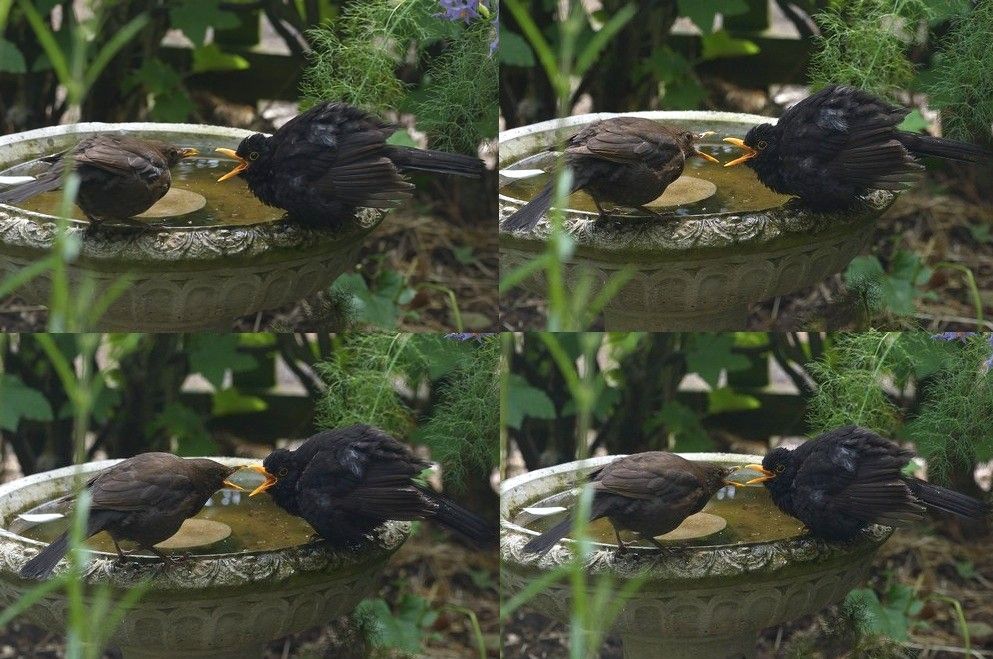
On looking out of the kitchen window (7th) I saw a pair of Blackbirds a few inches apart on the rim of the birdbath. They kept touching beaks with the beaks open and occasionally the female took a drink. This behaviour I have never seen before and am not sure exactly what was going on, although at no time did the exchange appear aggressive (see images below). A single of both Painted Lady and Red Admiral was present and the Cotoneaster splayed out against the shed’s brick exterior was humming with Bumblebees with a lot of them being Tree Bumblebees.
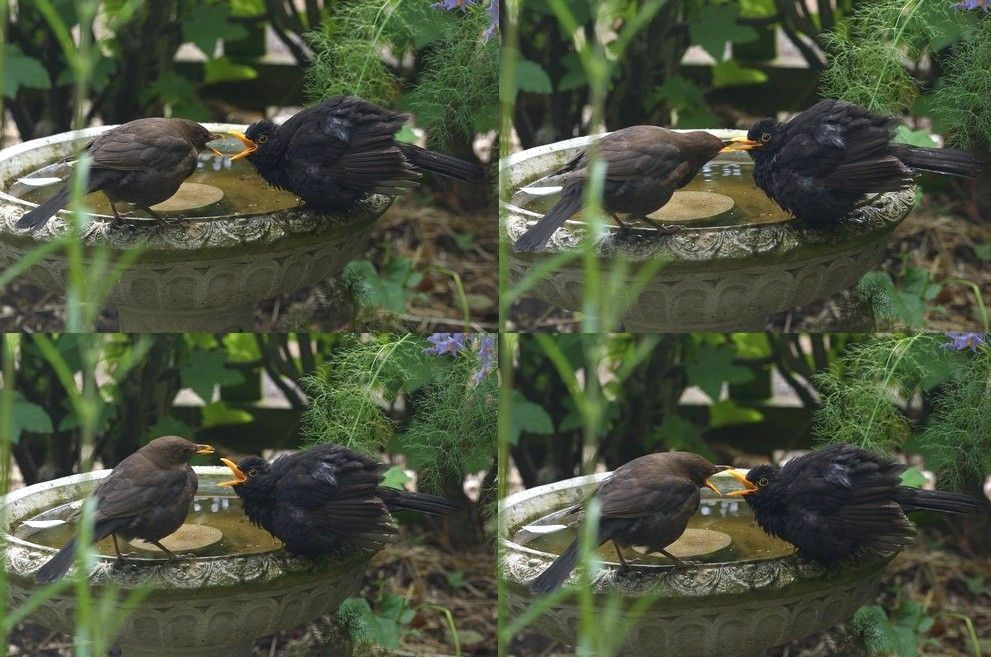
A single Swift was in the skies (8th) a Common Swift was indoors and Silver Y were once again in the garden later in the evening.
A Hedgehog was seen at 01.30 (9th) and during the day the rain continued to come down!
For only the second time, since I have lived here a Cuckoo was heard singing, somewhere to the east (10th). Although very distant, this was the first one I had heard anywhere this year.
Both a juvenile Robin (orange beginning to come through on its chest and belly) and a juvenile Blackbird was searching the bark path for food (11th).
Singles of both Painted Lady and Holly Blue were seen (12th) and 4 Swifts were overhead.
3 Swift today (13th) and a Hedgehog was present around 22.30.
Very much an avian juvenile day (14th), with juveniles of: Robin (different individual to the one seen 11th), Dunnock, Blackbird and House Sparrow (female searching the vegetation for insects). 2 Blue Tit were also present with one having a bath and a Stock Dove made another visit to the garden, while 5 Swifts were in the skies.
May 2026
Butterfly Influx and interesting Hedgehog sightings......
The last week of May turned out to be pretty eventful with interesting Hedgehog sightings and a Butterfly influx!
In the early morning (22nd) a ‘dark’ Hedgehog came into feed and drink at 03.45. However, I didn’t realise how dark this individual was until a very pale Hedgehog came in under the garden gate at 03.50. The new arrival appeared not to be welcome, although a mating attempt can’t be ruled out and the dark hog went towards the pale hog, which curled up in a ball. Both hogs stayed in the garden for some time; each keeping their distance from one another, before both Hedgehogs left the garden.
Later the dark Hedgehog returned at approximately 03.57 and took both food and water. After a cool period for weeks now, today saw the temperature go up, although, despite a prolonged watch on the garden; insect numbers did not go up! Nevertheless, a Holly Blue was seen and a Helophilus pendulus ‘Footballer Hoverfly’ were present and 3 Swifts were overhead.
A very warm/hot day (23rd), with BBC Weather predicting a heatwave in the coming days and today turned out to be a good ecological day.
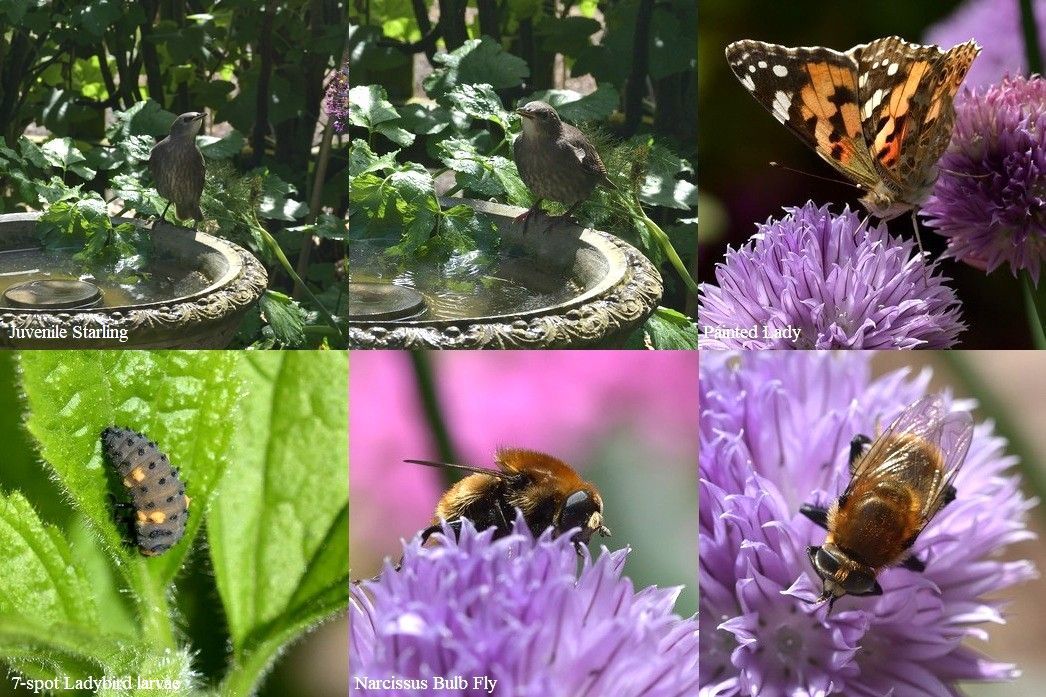
Juvenile Starlings were in the garden, bathing and waiting to be fed by their parents and 3 Swifts were again present. Watching them seemingly effortlessly move across the sky made me think that is there anything more graceful in flight than a Swift? Yet, like so many other species they are declining faster than I want to say. It is not impossible, but highly probable that this species will disappear from our skies and summer will no longer be summer. It saddens me to the point of despair what we as humans, have become, when we just destroy.
The JML latest invention (appearing in TV advertisements) is the ‘Double Zapper’ underlines this. A device to kill insects, indiscriminately, not only to use indoors but outdoors too! If interested, it shouldn’t be too hard to have a look at this device online, but I don’t want to advertise this terrible invention any more than I have already.
In the late afternoon I saw a Swift in the skies and then a ‘big swift’; my first Hobby heading inland.
Insects were more abundant today in comparison to yesterday and a Painted Lady and a Red Admiral were firsts for the garden this year and a Holly Blue was also present. The flowers of the Buddleia globosa are beginning to ripen into orange globes and the Painted Lady spent over 20 minutes on the one ripe flower, followed by visits from Bumblebees.
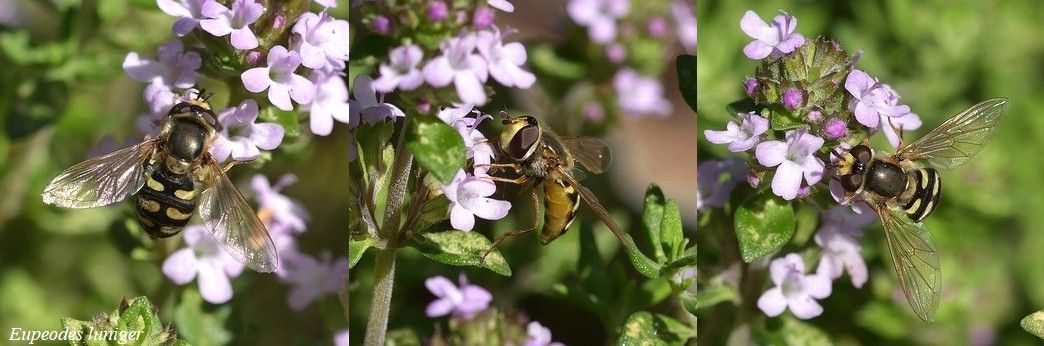
There were more visits from both Garden and Early Bumblebees and for the first time this year there was a bit of a buzz in the garden! A Red-tailed Bumblebee worker was favouring the Chive flowers and a Narcissus Bulb Fly Merodon equestris male (form narcissi-Naturespot) settled on the Chives too. Another Hoverfly was seen and photographed and was a Eupeodes luniger. This is said to be a variable and varying in size species, strongly affected by temperature at which the larvae develop.
Finally, around 18.00 the first Hummingbird Hawkmoth was seen around the Red Valerian and a Wren foraged for food on the Bronze Fennel leaves, a few feet away from me, picking off something from the leaves.
Hedgehog droppings on the path (24th) indicated what had been there during the night! 2 Kestrels flew over, a species that is not often seen here and in the garden were Painted Lady, Holly Blue and a juvenile Robin.
A Hummingbird Hawkmoth was seen in the morning (25th) and a Painted Lady was on the Chive flowers and on the Buddleia globosa. A possible Large White was seen briefly and a Holly Blue was also present. Bumblebee species seen were: Red-tailed, Buff-tailed, Garden, Carder and Early. A Red Kite was in the skies, as were 5 Swift, whilst a pair of Blackbirds hunted for food on the grass outside the garden; not surprisingly as this area mown by the council offer very little to wildlife. In the garden were 2 Goldfinch (regularly coming in to drink), Blue Tit, Dunnock, Wren and a juvenile Wood Pigeon was outside the garden. At 23.03 a Hedgehog came in to feed on cat biscuits and as usual a long drink, in fact most of the visitations by species of mammals and birds are to utilise the water put out for them.
Holly Blue and a Painted Lady (on the B. globosa) were present (26th) and the first Tree Bumblebee Bombus hypnorum of the year (a worker) was seen. 3 Swift and our first Swallow sighting were overhead and a Hedgehog was seen at 22.20.
A Goldfinch came to drink at the pond (27th) and both a Great Tit and a Blue Tit came in to bathe. A fresh Painted Lady was in the garden on the Red Valerian and a Hummingbird Hawkmoth was seen on two occasions on the Red Valerian at the front of the property. A Hedgehog was present at 23.49.
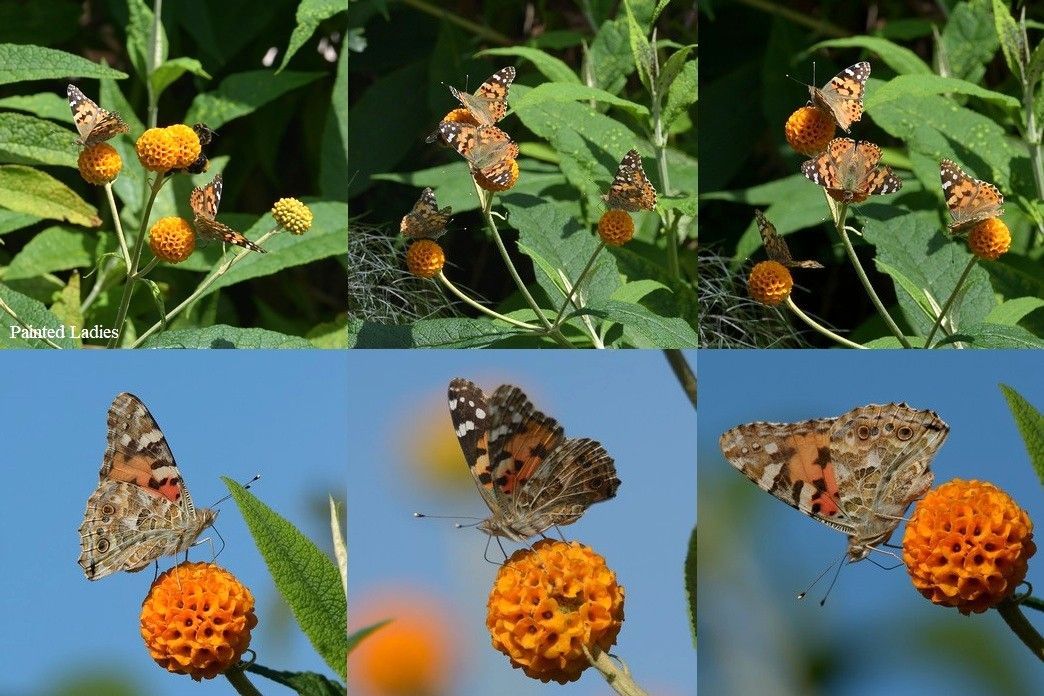
Numbers of Painted Ladies increased today (28th) to 7 individuals, part of what seems to be an influx into the UK from the continent.
The influx of Painted Lady butterflies gained pace in the garden today (29th) with 20+ estimated, but this could be a conservative number, with individuals landing on the other sides of the two Buddleia Globosa in the garden. Even the small planted area in the concrete slabs outside the community centre even had a Painted Lady and a Hummingbird Hawkmoth on the patch of Red Valerian. Also new in were 4 Red Admirals and a Holly Blue was also present. A Hummingbird Hawkmoth was visiting various Red Valerian flowers and Bumblebee species included: Tree, Buff-tailed, Early and Carder. A juvenile Robin, Goldfinch, Wren were in the garden, while 2 Swift were overhead. A Hedgehog came for a drink at 22.32.
I had never seen so many butterflies in the garden here a couple of days ago, but today (30th) superseded what had gone before. 50+ Painted Ladies; the great majority on and around the two B. globosa were quite a spectacle to see as they chased each other and flew up into the air together. 4 Red Admiral and a Holly Blue were seen again but new in was a single Small Tortoiseshell, also on the Buddleia. 2 Great Tits came and bathed together (probably a pair) in the pond and 2 Swift were overhead.
Later, at 22.30 a Hedgehog was seen in the garden (although it may have been present earlier as all the food put out was gone. It was very shortly followed by another hog, which pushed into the first hog, trying to get underneath it. The Hedgehog being pushed curled up in a ball. I put some more food out and both Hedgehogs stayed put; one still in a ball and the other freezing, something I have seen them do before. The ‘aggressor’ or would be suitor left the area and after a while the original hog uncurled from its ball and began feeding and as usual had a drink.
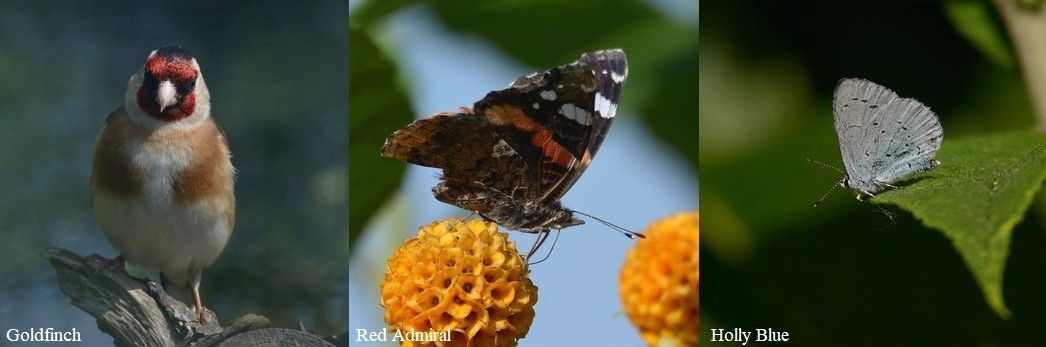
Less numbers of Painted Ladies today (31st) with around 10 seen but 2 Small Tortoiseshells were present. Numbers of Red-tailed and Tree Bumblebees were more obvious with their presence and ‘Bird bathtime’ during the mid afternoon included 2 Great Tits, a pair of Blackbirds and several House Sparrows, which were also feeding on Forget-me-not seeds; a Wren and 3 Swift was also seen.
New Dragonfly for garden, Rat sightings stop and Hedgehog visits......
The second and third week of May began (9th) with another new species for the garden-a Broad-bodied Chaser! Now, I know from studies on Broad-bodied Chasers I did many years ago, in my garden at Forncett St. Peter, that they disperse almost immediately and this is probably what this teneral/female-looking one did and it wasn’t long in the garden either! A few erratic darting flights and it was gone. Great to see though and possibly of interest from those study days: House Sparrows were catching teneral Broad-bodies in flight and snapping their wings off before consuming them, almost Spotted Flycatcher-like!
Also in the garden were workers of Carder, White-tailed and Early Bumblebees and a Holly Blue. Birds of note were bathing Great Tit, House Sparrow and Starling and 2 Dunnock. A Brown Rat was also seen.
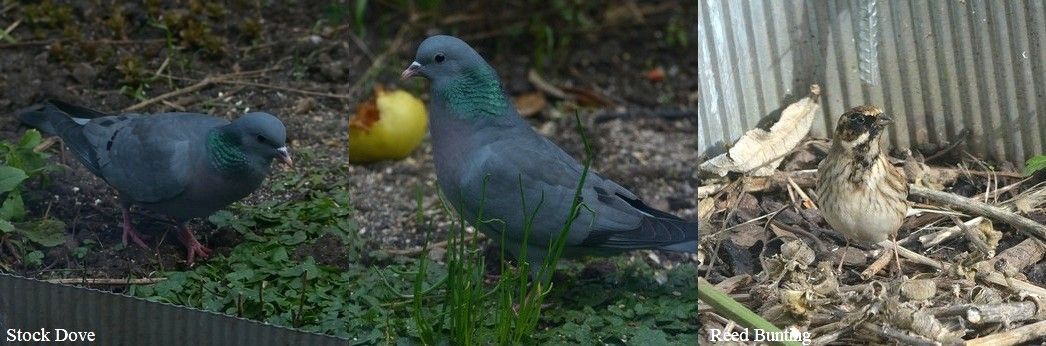
A Stock Dove alighted on the edge of the pond (11th), amazing to see the amount of visits the garden is getting from this species! A Great Tit came in for a bath, a queen Carder Bumblebee was seen, as was a Brown Rat-again!
A Holly Blue was again present (12th) and other insects included White-tailed and Early Bumblebees. A Wren was present, as were Brown Rats; with at least three different individuals seen!
Hail showers and rain today (13th), but a Red Kite was seen in the skies, a juvenile Robin in the garden and a Brown Rat.
A Great Tit was once again coming into the garden to bathe in the ‘Hedgehog bowl’ (14th) and a Wren was seen and yes, so was a Brown Rat with another sighting the following day (15th).
2 Goldfinch came to drink at the pond (16th), a Great Tit had a bath, 3 Mallard (2 drake and duck) came into the garden and had a drink and the duck explored the vegetation for prey. 2 Brown Rats were seen-unfortunately.
The/a juvenile Robin was again in the garden (17th), a Dunnock was bathing in the pond, as was a Starling in the bird bath and a Hedgehog dropping was found on the path, proving that they are still around despite no food placed out for them because of the Brown Rats.
The juvenile Robin was present (19th), as was a Wren.
Early and Carder Bumblebees were visiting the Cotoneaster flowers, along with a Common Wasp (20th). Juvenile Robin, both male and female Blackbirds and the first juvenile Starlings (outside the garden) were all seen.
The first Swifts from the garden were seen today (21st) with three flying around in formation, after a single bird had been seen. Both Blue and Great Tits came into bathe, a Wren visited on two occasions and an adult Robin (long time no see!) were present. A Holly Blue was good to see again, with the air now a lot warmer (more to come, according to BBC Weather!), Carder and Early Bumblebees were around the Cotoneaster, whilst a White-tailed was also see, mainly on the Red Campion and a worker Red-tailed Bumblebee was on the Chive flowers (only the second red-tailed this year).
With no sign of any Rats for the last few days (night or day), I decided to put out some food for the Hedgehogs and at 22.40 I was rewarded with a very dark Hedgehog coming for the cat biscuits and to drink. What looked like the same individual hog returned at 23.30 and again had some food and water. I kept a watch on the garden throughout the night and saw no Rats!!
Migrants on the Norfolk coast and a couple of distant rarities......
A long-awaited day out with Jason Nichols (14th) saw us heading north along the Norfolk coast, experiencing both hail and rain showers en-route.
The sun did appear periodically but the northerly orientated winds made outside the car very chilly! However, we encountered two Swallows on telegraph wires at Weybourne, which were very welcome, as they were my first (not many Swallows around Martham!).
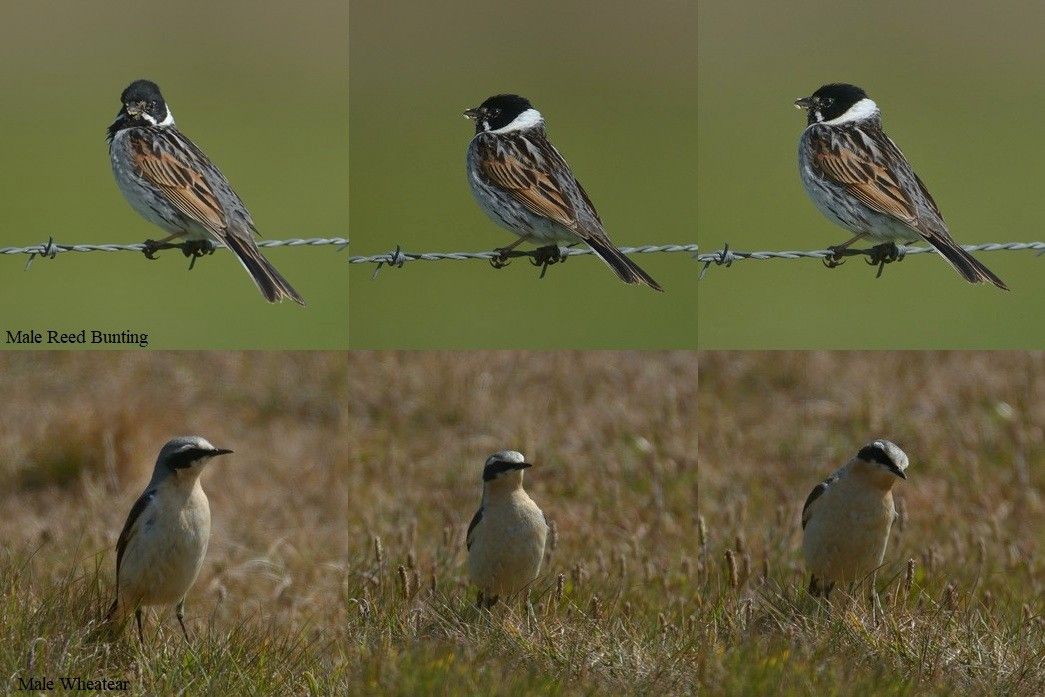
A look along Beach Road, Salthouse followed and here we heard and briefly saw 2 singing Sedge Warblers, once again another first of the year and there were more to come. A male Reed Bunting posed for photos and a few Avocets were feeding in the dyke and a pair of Stonechats were along the beach fence line to the east, followed by another male on the western side. Heading back down the road we saw some distant Sand Martins and back on the coast road we saw the martins a little better and they were followed by our first Swifts.
A walk along the Iron Road at Salthouse found a distant Great White Egret and singing Sedge and Reed Warblers. 5 Dunlin and Avocets were on the main pool (Swan Lake) and good numbers of Sand Martins and low-flying Swifts.
Travelling up Beach Road, Cley we stopped to photograph a male Wheatear, which Jason had spotted (which he often does, but it was on his side of the road!). There was not a single bird from Coastguards, so we decided to explore the roads around Salthouse Heath.
A Willow Warbler was heard singing, as was a Blackcap, otherwise the woods were very quiet! Parking up further along we heard nothing, nor saw much either; The Silent Heath! However, one bird was singing; a Tawny Owl, possibly two!
Next stop was Morston. Not too much here either, except for approximately 60 Brent Geese. However, I was scanning the surrounding area, as there had been a male Red-backed Shrike here the previous day but hadn’t been reported today. I could see a few birdwatchers along the path further on but did not appear to be watching nothing. As I scanned along a low ridge of vegetation in the distance, I saw something on the top of a plant. At first, I wasn’t sure if it was even a bird, but then the ‘object’ flew down before perching up again! Jason brought his scope out and I managed to find the ‘blob’ again and could see that it was a Red-backed Shrike. Jason managed to look and see it fly down again, but with people with fluorescent attire walking around the area, we could not locate the Shrike again. However, a Spoonbill spotted by Jason (I was looking for tiny images in the distant haze!) flew over, so a good result here in the finish.
At Well’s Pools there were good numbers of Sand Martins and Swifts, mainly over the pools, where there were several Avocets and a Chinese Water Deer hiding in the rushes.
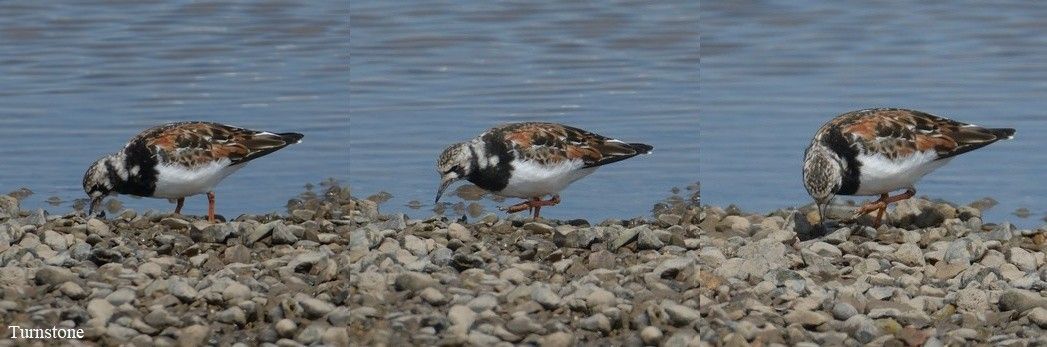
We stopped for lunch at Brancaster Staithe and found a very nice Turnstone in summer plumage. However, there was not too much here, but we managed to find a total of 10 Ringed Plovers, Oystercatchers and a species not seen here before were a pair of Gadwall, which flew in and settled on the water.
A drive around Choosley Barns eventually found a Common Whitethroat, followed by a good few more. A few Butterflies were on the wing, mainly Green-veined Whites and at least 8 Brown Hares were seen. We stopped alongside the road just before joining the main road again and Jase heard a Cuckoo. It apparently called only once, so I didn’t hear it. I then realised this happened last year in exactly the same spot! Nevertheless, I found my first Wall of the year and other butterflies included 3 Painted Ladies and several Orange-tips.
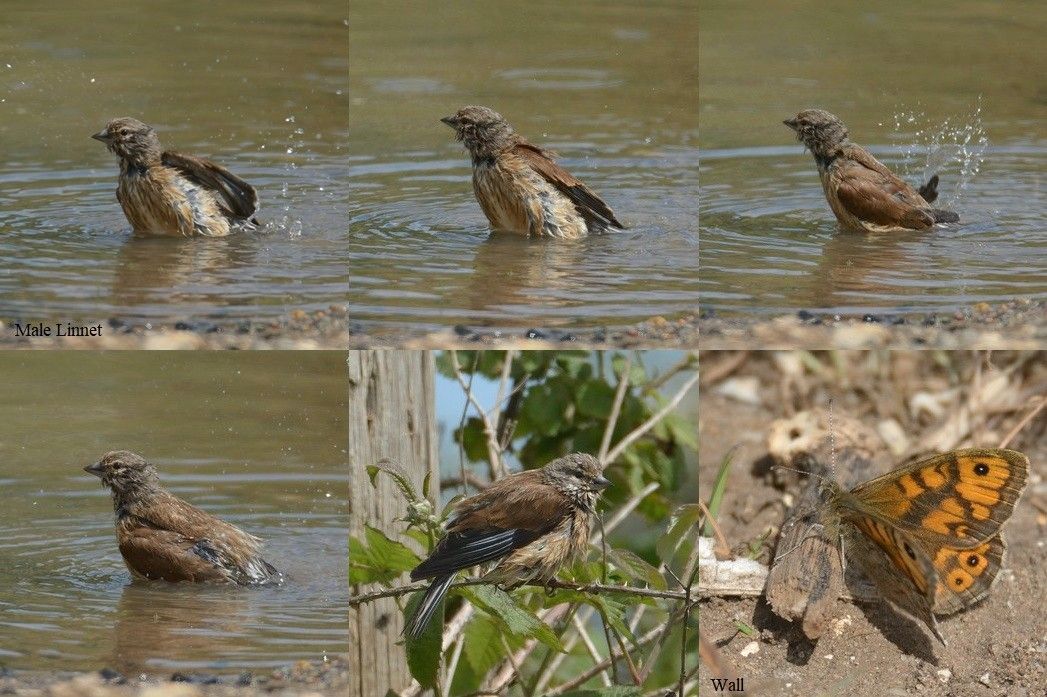
At Burnham Norton we finally connected with a migrant, which had not been seen anywhere along the coast; a House Martin. As it turned out a good number were over the pools, even coming down to collect mud. Another Wall was seen and other birds recorded were Red Kite, Green Woodpecker (heard), 10+ Avocet, Swifts and Little Egrets.
A stop overlooking Burnham Overy Dunes didn’t find too much but a flying Great White Egret was welcome.
At the ‘gate’ at Holkham a few Spoonbills could be seen coming and going and then we found 2 Cattle Egrets, as well as Little Egrets, meaning we had seen all three egret species for the day.
A short distance along the road from the pull-in we found another Cattle Egret with cattle and 2 Barnacle Geese (from unknown origin-as they say!).
The news finally came in that the omnipresent Black-winged Kite had been seen at Lessingham again, but had flown off towards Sea Palling. Nevertheless, we went to investigate and finally came across a small group of people, obviously looking for the kite, but apparently it had not been seen. Still, we stayed, seeing 3 Kestrels, Common Buzzard and Red Kite. Over an hour later someone said they could see it, in a bush but you couldn’t see it now! However, the kite flew out from the back of the bush and eventually perched at the top of another bush. I fired off a few camera shots, but without much hope of capturing anything worth keeping and so it turned out-far too distant and in a heat haze. Still, patience had paid off and we left the very noisy group and headed back via Sea Palling, where at one of the paddocks there were several of my favourite mammal-Rabbits.
However, on passing the pull-in at Horsey it was nearly all covered with rubbish! Horsey was the latest victim of Fly-tipping, is nothing sacred?!
However, a very good day out and very productive with good company. Hopefully the next trip will not be so long in coming!
New Butterfly & multiple sightings of Hedgehogs......
The first week or so (1st-8th) found a new Butterfly for the garden and a good number of Hedgehog sightings.
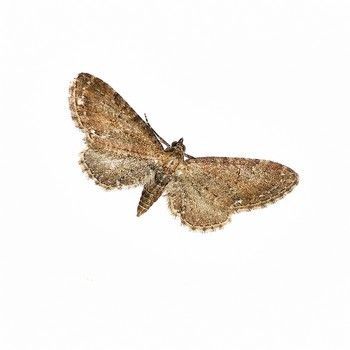
A Wren was good, as always to see (1st), a Common Mourning Bee and there were several Hoverflies around but not that much in the way of insects, although there was a Pug moth on the bathroom ceiling, which Ken Saul tells me: is Common Pug Eupithecia vulgata (pictured right), which can be quite variable, but the white spot at the bottom corner of the forewing, together with the small black discal spot are pretty consistent, and a good identification feature.
However, the evening was a different story, where mammals were concerned, with a lot of Hedgehog activity, beginning at 22.00, when there was a ‘medium’ sized hog seen heading for the gate. Some food was put out and later at 22.53 a small Hedgehog was in the garden, followed by a very dark-faced medium sized hog at 22.57. A very small Hedgehog was then seen at 22.59 and at 11.01 there was a small and medium hog, which were having a ‘face-off’ with much ‘snuffling’ noises, while a very small hog was looking for food in the border. Three hogs were now in the garden and at 11.20 all three were still present with the ‘snuffling’ noises continuing non-stop!
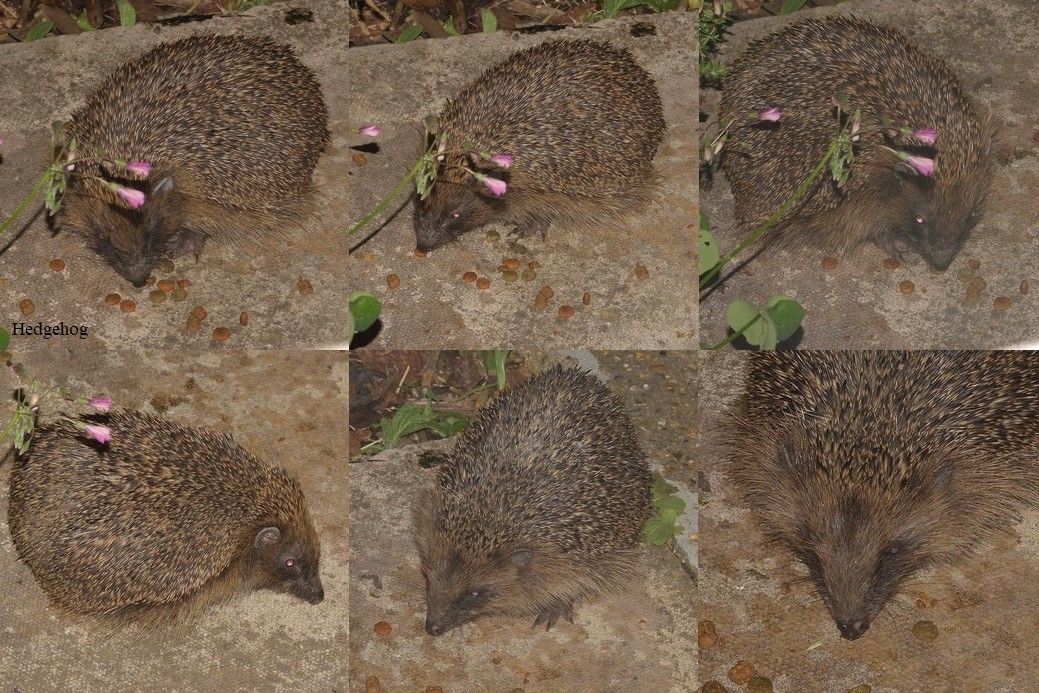
Following on from the 1st, at 00.33 (2nd) a small Hedgehog ran off when a medium sized Hedgehog entered the garden by way of underneath the garden gate. Not so good to see was a Brown Rat!
2 Holly Blues were in the garden, on my return from a trip to Filby, but whilst sitting in the garden a Speckled Wood (in pristine condition) arrived and perched on a Hazel leaf! I went in the kitchen to get the camera, but in those few seconds, my first ever Speckled Wood in the garden was gone! However, this is the 18th species of Butterfly in the garden (which includes Swallowtail and Grayling), with two other species (Small Copper and Small Heath) seen outside the garden; not bad for a small plot originally full of plastic and concrete and barely any plants! A Grey Squirrel was also around, as was a Brown Rat again.
At 21.30 there was a Hedgehog by the back door and at 21.55 a different individual came in and had a very long drink in the small bowl. With little rainfall, there is a great need to put out water for Hedgehogs and the ones coming into the garden certainly have a thirst.
A Holly Blue was in the garden again (5th) and Blue Tit, Great Tit and Wren all came to bathe; the small ‘hedgehog bowl’ being a favourite.
A medium Hedgehog was seen at 00.06 and after food was put out it came back after a few minutes. Unfortunately, so did a Brown Rat but I scared it off by rattling the door handle (on three occasions!), but luckily the hog remained and I stood in the kitchen watching the Hedgehog feed until it had consumed all the cat biscuits. At 01.06 the hog had a very long drink and 5 minutes later was joined in the garden by another individual of similar size, but this one was more dominant and the initial hog backed away, whilst the new arrival also had a very prolonged drink.
A Great Tit has become regular in the garden, mainly coming to bathe and today (7th) was no different. A pair of Goldfinch arrived to drink at the pond and another one came in to do the same a little while later. A Robin also came in for water; to bathe in the late afternoon.
A Large White and Holly Blue were in the garden (8th) and a Goldfinch and Great Tit came in for water, with the latter bathing. Unfortunately, the presence of Brown Rats still remains and two together at the back of the border were scared off by rattling the door handle. There are no areas for them to breed and no food source in the garden and they are coming in from next door, who has a habit of filling up a bird bath with ‘food’ which is there overnight and has covered his gravel with plastic grass, which I am pretty sure is where the rats are residing.
A Hedgehog came to drink at 22.25 and another individual with pale patches on its back came in shortly afterwards, at 22.31
The Rat situation leads me nicely on to Sir David Attenborough, who also does not like Rats! But more importantly it is his 100th birthday today. Many of us have grown up with Natural History programmes presented or narrated by Sir David and I remember in particular a programme (think it was Zoo Quest-a long time ago!), which was filmed in black and white on a trip to capture a Komodo Dragon, which I found as a small boy very fascinating. Whilst I doubt very much that he looks at this website, I nevertheless would like to thank him for all he has done for educating the world with his programmes (aided with superb naturalists and camera men and women) and enthusing people about the ecology of planet Earth and the importance to look after other animals than ourselves, which we all depend on for our existence. HAPPY 100th BIRTHDAY, SIR DAVID, I hope you have many more, but what an innings nevertheless!
Visit to Filby, but management is very much in question!
A visit to Filby (2nd) found a few animals of interest but life was, in general thin on the ground.
Two Garden Warblers were heard singing near the car park and on the way down to Ormesby Little Broad viewing area a Blackcap and a Reed Warbler was heard.
However, as predicted this new path was being used as a cycle track with two young lads on bikes, one with ‘music’ blazing out, came towards me at speed, but I didn’t get out of the way so they had to stop.
No doubt this solid path has probably been laid to aid disabled people have access to the area. However, these are people with visible disabilities and fair dues the new path is good for them, although cyclists are going to be a hindrance to those people with mobility aids. I would argue that people who have ‘unseen disabilities’ (just because you can’t see a disability, it does not mean there isn’t one), for instance mental health problems (such as myself) no longer find the area to be in touch with nature as it once was and personally I do not find pleasure in the walk down to the broad anymore, where once upon a time there was lots to explore and lots to find, but now that habitat has been wiped out. In essence, this new path and the clearance of a lot of plants have rendered this area into a tourist attraction (along with silly signs highlighting Swallowtail and Bittern; really?!), with no concern for the flora and fauna there.
I understand from Ken Saul that the area is owned by Essex and Suffolk Water and managed by the Norfolk Wildlife Trust via the Trinity Broads project. Well, I would like it explained to me and others what this ‘Trinity Broad project’ is and who is making the decisions about this area and others.
I have seen how the NWT manage areas, which they have purchased or obtained and their conservation management is something to be desired and not necessarily right for a particular area. But like the council the NWT are a law onto themselves.
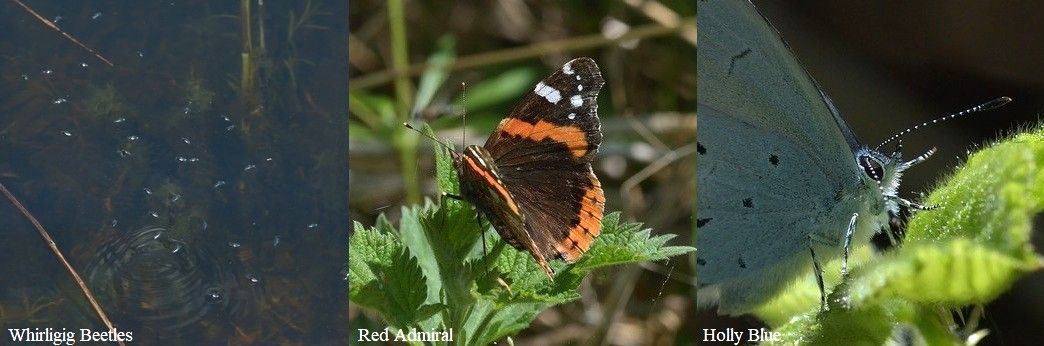
Down at the viewpoint another Reed Warbler was heard and a Common Tern flew past. There were also a good number of Whirligig Beetles on the surface of the water, above the cans and bottles thrown in there by what is obviously the NWT’s and the Trinity Broads Project target audience!
I found a solitary Large Red Damselfly and a couple of Variable Damselflies. A few Butterflies were seen: Large and Green-veined Whites, Orange-tip, Red Admiral and Holly Blue.
April 2026
Second half of April sees Hedgehogs in the garden and some new Bees for the year......
Both a Goldfinch and a Greenfinch came to drink from the pond (16th) and Great Tit, Blue Tit, 3 Wood Pigeon, 2 male Blackbird, House Sparrows and a Starling were also seen. A Grey Squirrel was a visitor, once again.
Hedgehog droppings were found on the front grass (17th).
The first Holly Blue was in the garden (18th) and a male Brimstone was also present briefly. Great Tit, 2 Blue Tit, Goldfinch (drinking from pond) and a Wren were also present. 2 Sparrowhawks were circling overhead and tow mammals were in the garden; a Grey Squirrel and a Brown Rat!
A juvenile Blackbird was in the garden (19th) and a Robin bathing was the first sighting for a while. A Grey Squirrel was also present.
Two juvenile Blackbirds today (21st), with one being fed by a female. A Brown Rat was seen again, this time a different individual, but the one run found has now been cleared.
A Hedgehog walked along the bark path at 20.00 (22nd). Still light but great to see our first hog of the year.
A Stock Dove was on the grass area behind the garden (23rd).
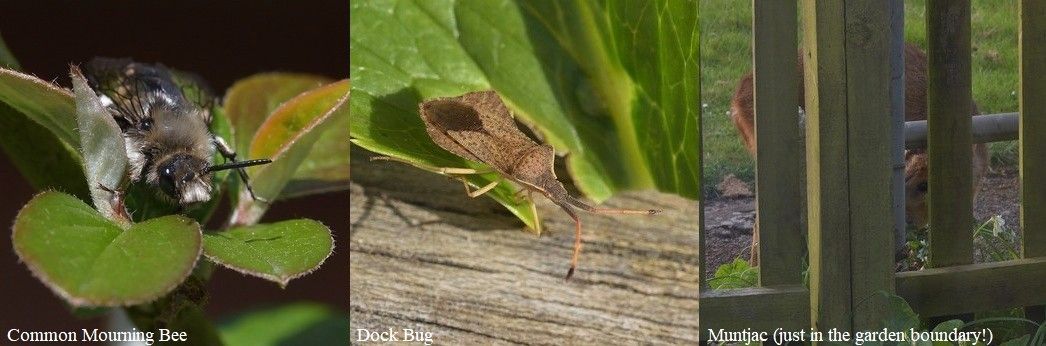
Hedgehog droppings were found (24th) and firsts for the year were a Large White and a Red Mason Bee Osmia bicornis. Common Mourning Bee, a female Hairy-footed Flower Bee and Buffish Mining Bee were also seen. A juvenile Blackbird was present again, as was a Wren and two, what looked like adult Hedgehogs were in the garden (one feeding on cat biscuits, the other having a long drink) at 21.47.
A Comma was new for the year (25th) and a Holly Blue was also seen. Later a different smaller Hedgehog was in the garden at 22.26.
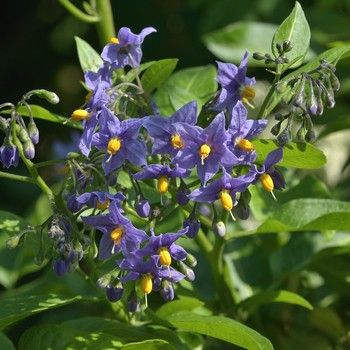
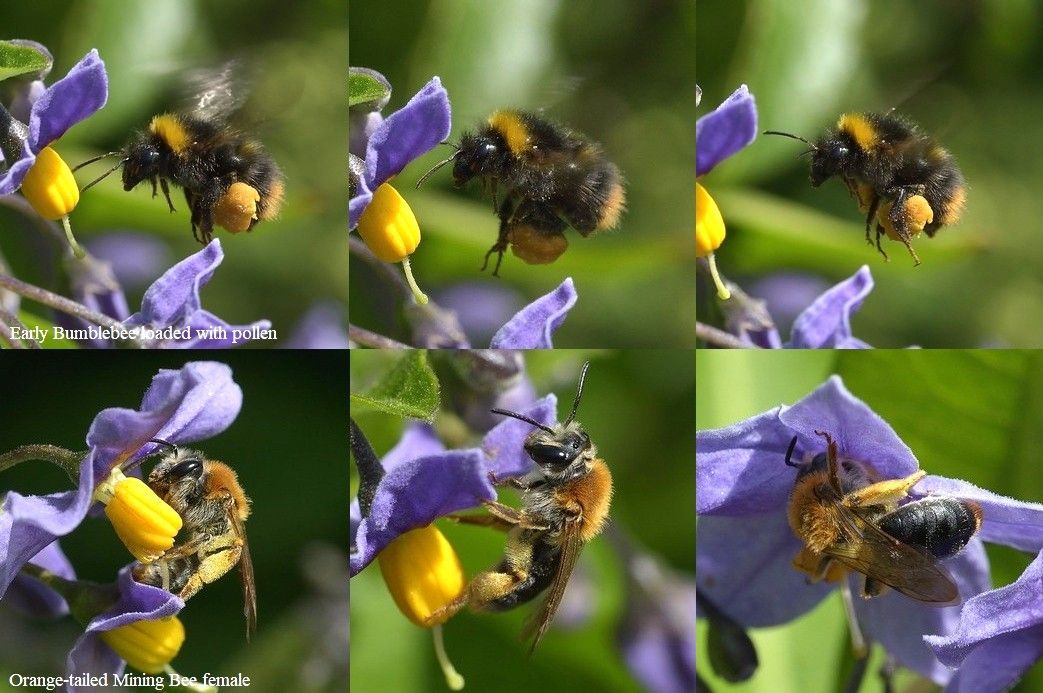
A Hedgehog (same individual as 25th) was seen in the early morning at 04.45 (27th). Holly Blue and Green-veined White were in the garden as was a Common Mourning Bee. The Chilean Potato Vine Solanum Glasnevin was attracting Bees to its typical Solanum flowers and the first Orange-tailed Mining Bee Andrena haemorrhoa female of the year was present along with a Carder Bumblebee, heavily laden with pollen. The Chilean Potato Vine (pictured right) is quite a useful plant for wildlife. I took a cutting from the shrub coming over my fence from next door and it is now ‘climbing’ up my arch. The flowers are attractive to insects and the black berries are attractive to birds, so not a bad shrub to have in the garden.
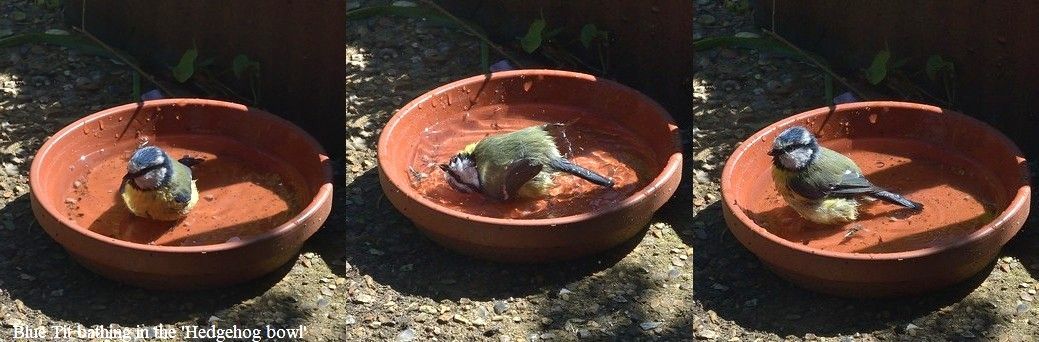
A Hedgehog was present at 22.55 and at 23.15 (28th) and a Blue Tit was photographed as it bathed in the small Hedgehog water dish, from the kitchen and with a macro lens!
A Hedgehog was seen at 12.30 and then later in the evening at 22.43 (30th). A Holly Blue was also in the garden.
First Dragonflies......
A trip to Filby (23rd) found my first Dragonflies of the year and a few avian migrants.
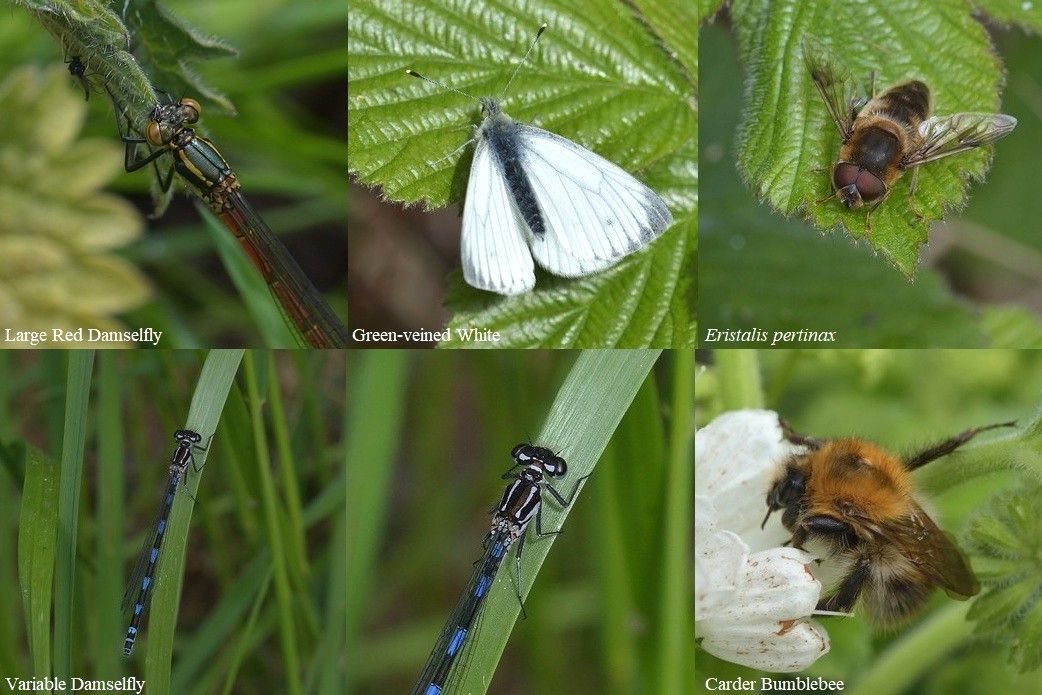
As I began walking down the path to Ormesby Little Broad, I found a Large Red Damselfly in the short vegetation. No more dragonfly activity was seen, but a Green-veined White was resting on a leaf in the far from warm conditions, despite the ride being reasonably sheltered. However, the amount of cover and places I used to find insects are to longer here; no doubt due to some misguided management plan!
A Reed Warbler was heard singing and another one was heard from the viewpoint. A pair of Great Crested Grebes were displaying out on the broad and there was a raft of 8 Tufted Duck.
On the walk back I heard a few Blackcaps singing and also a Chiffchaff, before arriving back at the car park.
I went to investigate the Brambles along the path leading to the bridge; this has been a happy hunting ground for insects in the past, but again this has been cut back. However, I found 2 Variable Damselflies here and a couple of Tapered Drone Flies Eristalis pertinax Back in the car park; 3 species of Bumblebees: Buff-tailed, Carder and Early, mainly on the Green Alkanet flowers.
First Orange-tips and Alderflies and a Roebuck during a short trip locally......
A look around the local area (17th) began at Filby and on entering the car park I saw my first male Orange-tip. A few minutes later I saw two female Orange-tips ‘sparring’ in the air and later still; saw another female near the Ormesby Little Broad viewing platform.
Still in the car park I heard a Common Tern calling, somewhere above me but couldn’t find it.
The walk down the path (or potential cycle track!) heard a Cetti’s Warbler singing but the woodland was very quiet and there were very few insects on the wing and therefore no sign of any Large Red Damselflies seen here in recent days by Ken Saul.
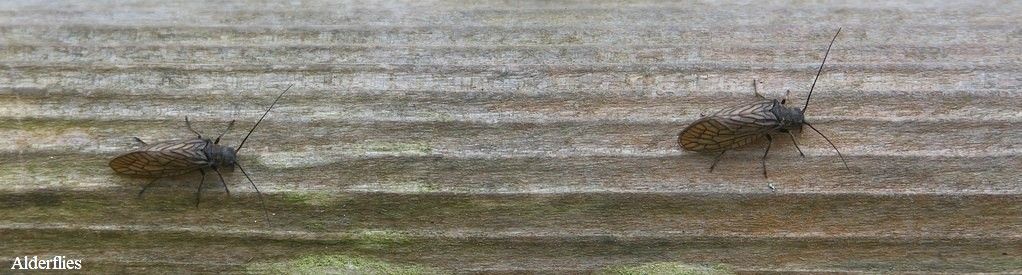
At the viewpoint, several Alderflies Sialis lutaria were perched on the wooden railings and there was a Great Crested Grebe and a pair of Tufted Duck on the water. Then, I picked up on a bird flying at speed just above the water; a Common Sandpiper.
The empty bottles and litter left behind at the viewpoint and elsewhere by people who do not appreciate the environment, is highly annoying and sad to see.
Heading back along the path I heard a very short burst of song, which I thought maybe a male Blackcap and indeed it was. I waited for the elusive individual, which was keeping behind the branches and only giving brief views in flight and finally I had a clear view of it.
I decided to have a look along the coast and the first birds of note I came across were a pair of Cranes from the Horsey ‘lay-by’ and a Common Buzzard, whilst across the road on the grass field I found 7 Pink-footed Geese still present.
A drive down the track to the woods at Horsey Gap saw very little but I did hear what might have been a Willow Warbler’s part song. On the return journey along the track, I spotted a deer laying down. It was a Buck Roe Deer and although at distance and hazy light, I took a few images.
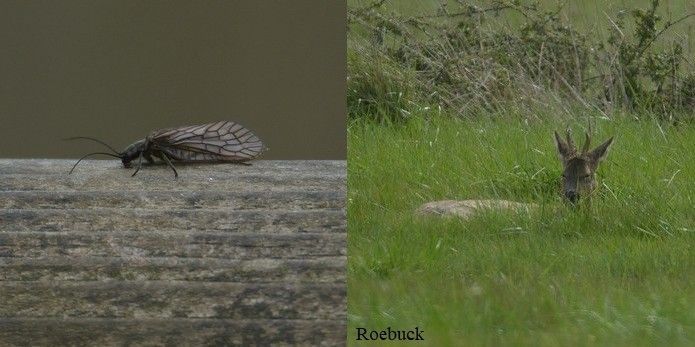
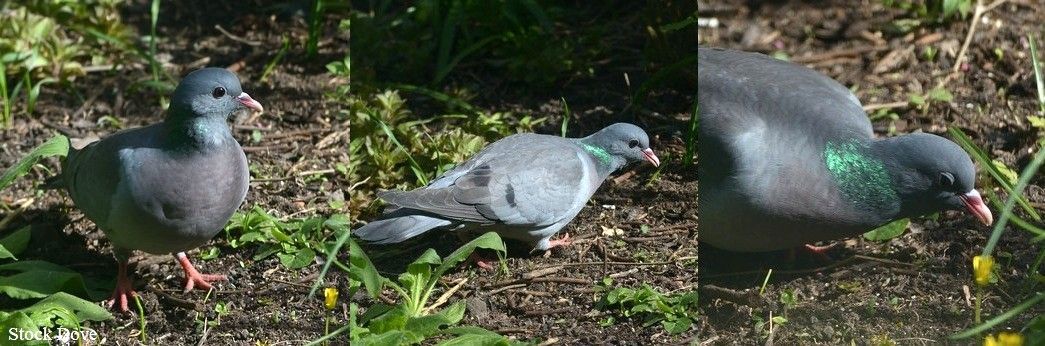
New Garden insects for the year, a Muntjac and continued visits from a Stock Dove......
The month began (1st) with a queen Buff-tailed Bumblebee and birds present were: 2 Dunnock, 3 Wood Pigeon, Rook, male Blackbird, Collared Dove, 2 Blue Tit and a Starling.
A female Buffish Mining Bee was seen (2nd) and a Stock Dove was present again; great to see this attractive Dove coming into the garden so often.
A female Hairy-footed Flower Bee was at the nesting facilities (4th) and both a Small Tortoiseshell and a Common Wasp Vespula vulgaris were seen.
2 Jackdaws were in the garden (5th), with one gathering large quantities of packaging wool left out for the birds to use as nesting material. Very similar to how Jackdaws pull out hairs from animals such as Deer and Sheep. A Stock Dove was again in the garden, feeding on spilt seed on the ground. The first Red-tailed Bumblebee Bombus lapidarius was seen and 2 Great Tits were bathing.
A male and female Hairy-footed Flower Bee was visiting Three cornered Leek flowers (6th), a male Buffish Mining Bee and a Buff-tailed Bumblebee were also present.
A Carder Bumblebee Bombus pascuorum queen was the first of the year (7th).
An Early Bumblebee Bombus pratorum was the first of the year (8th), visiting the Flowering Currant flowers and the first Common Mourning Bee Melecta albifrons (the cleptoparasite of Anthophora plumipes aka Hairy footed Flower Bee) was seen. A female A. plumipes as was a Buffish Mining Bee. A very notable sighting was 2 female Greenfinch coming to the pond to drink on two occasions; a species that is a very uncommon visitor to the garden! A wren came to bathe, first trying the bird bath, which it didn’t find to its liking but eventually bathed in the much smaller and shallower ‘frog bird bath’.
A Grey Squirrel raided the garden for food, consuming both fruit and seed (9th). A female Blackbird took pieces of vegetation from the pond and then collected damp compost from a recently potted Rosemary plant, before flying off with the materials, to use for nest material. What appears to be a Melangyna lasiophthalma Hoverfly was also found resting on a leaf and a first for the garden was a ‘small’ Coreus marginatus Dock Bug.
A Muntjac was seen (10th), around 7.00 outside the back garden, but came right up to the garden gate and fence to graze, inside the metal pipe that dictates the garden’s boundary. A case for a garden tick?! The second mammal of the day was when, once again there was a visit from the Grey Squirrel.
A Red Kite flew over (11th).
March 2026
First Solitary Bees and another nesting facility added for A. plumipes in 2nd half of March......
The second half of March, began (15th) with the first sighting of a male Hairy-footed Flower Bee Anthrophora plumipes, zipping around the garden at speed.
The first butterflies of the spring appeared in the garden (18th) with a Small Tortoiseshell and then a Peacock visiting the Blackthorn flowers. The first Dark-edged Bee-fly Bombylius major was also seen and a Buff-tailed Bumblebee was also present.
The third Reed Bunting (sub-adult male) of the year in the garden appeared (19th), feeding on the spilt seed on the ground.
A third Reed Bunting was in the garden (19th), again a sub-adult male.
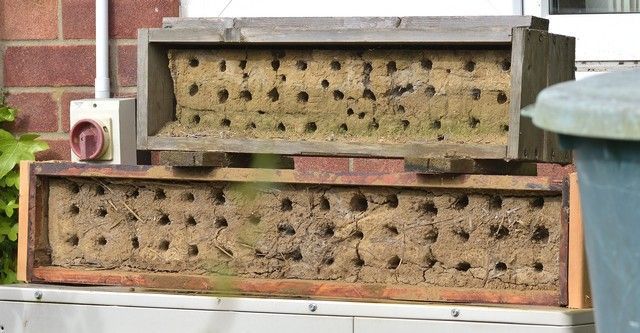
A shower of sleet/hail came down (25th), but didn’t put off a visit from a Stock Dove, which fed on the ground, underneath the feeding station. The new case filled with a mixture of cricket pitch loam, sand and straw and with holes, for Anthophora plumipes was placed outside; underneath the existing complex (see image below).
A Blue Tit was seen picking up Rabbit hairs (26th) from the bark path and seemed to take them in the direction of the nestboxes on the shed wall.
The first Buffish Mining Bee Andrena nigroaenea (male) was seen (30th) settling briefly on a leaf before flying off again.
First Bumblebee and infrequent avian visitors in the first 2 weeks in March......
The start of the month (1st) saw a Great Tit, 2 Wood Pigeon, 2 Blackbird, House Sparrows and a Dunnock in the garden. Also, lovely to see the Blackthorn in flower.
The first Bumblebee of the year was seen fleetingly (4th). Probably a Bombus terrestris Buff-tailed Bumblebee and a Stock Dove was in the garden picking up seed, mainly chucked out of the seed trays by Collared Doves. Although this is not the first time a Stock Dove has been in the garden it is by far not a common occurrence.
A new case filled with a mixture of cricket pitch loam, sand and straw and with holes made in the mud was made today for Hairy-footed Flower Bees Anthophora plumipes. The original one is now in its 4th year, but the substrate is now falling to bits, so time for another one, in addition to leaving the original in place. There is no sign of any A. plumipes as yet but shouldn’t be long. For details on how to make your own mud bricks see Anthophora plumipes Hairy-footed Flower Bee on Wildlife Articles.
The/a Stock Dove was again in the garden (7th).
A Blue Tit was heard tapping inside one of the nestboxes (9th). This is not the first time, but one of many times I have witnessed this behaviour by Blue Tits. The reason for this I am not clear about.
A Wren was present today (10th), as was a Stock Dove again.
The second Reed Bunting of the year was searching for seed underneath the feeding station (12th). With an incomplete head pattern; presumably this was a sub-adult male.
The Stock Dove was back again today (13th).
A Buff-tailed Bumblebee was in the garden (14th) visiting the Blackthorn flowers. The Blackthorn did not flower the first year it was planted, so good to see it flowering now.
February 2026
February sightings in the garden......
The month began (1st) with a selection of birds in the garden: Wren, Great Tit, 2 Blue Tit, Dunnock, Starling, 3 Blackbird, 2 Wood Pigeon, 2 Collared Dove, several House Sparrow and a Robin.
The large tree behind the property (Whitebeam?) was completely felled today (3rd) by the council. Another tree has been planted, so at least that’s something!
7 Blackbirds were in the garden, along with 4 Collared Dove, 2 Wood Pigeon, Dunnock, Robin, House Sparrows and a Blue Tit.
Peculiarly, a fatball and a piece of bread were found in the garden in close proximity to each other. How they got there is not certain, but it would appear that one of my ‘lovely neighbours’ chucked them in the garden.
A Grey Squirrel was once again (4th), this time sat on the ground with a fatball (found yesterday) in its arms!
2 Blue Tits were investigating the nestboxes and 3 Dunnock, 3 Wood Pigeon, Wren, 6+ House Sparrow, 4 Blackbird, Collared Dove and Robin were also present.
Robin, 2 Dunnock, 6 Blackbird, 4 Collared Dove, 2 Wood Pigeon, 8+House Sparrow and a Starling all visited the garden (5th).
A Stock Dove was seen outside the garden with Wood Pigeons; congregating around where the tree had been felled for some reason? The Stock Dove hovered over the garden briefly but did not land. 4 Wood Pigeons were in the garden with a further 7 outside the garden and 2 Blue Tit, Great Tit, Dunnock, 4 Blackbird, 2 Collared Dove, House Sparrows, Robin and 8 Starling were also seen.
5 Collared Doves were in the garden together (8th & 9th), which may be the highest number ever recorded.
Great Tit, Blue Tit, 2 Blackbird, 4 Wood Pigeon and 5 House Sparrow were all in the garden (18th).
The Grey Squirrel was present again (21st & 22nd) burying unknown items!
The Grey Squirrel was helping itself to a Pear (23rd) put out for the Blackbirds (and any other avian takers!).
7 Wood Pigeon were in the garden, which might be a new record. Also here were: 10 House Sparrow, 4 Starling, 2 Blue Tit, Dunnock, Collared Dove and 3 Blackbird.
Today (24th) was warmer than of late with temperatures reaching 17 degrees C. Probably not temperature related but the first Reed Bunting of the year was in the garden; perched in one of the seed trays.
Also seen were: Dunnock, 3 Blackbird, 2 Wood Pigeon, House Sparrows, Blue Tit and 2 Collared Dove.
The Grey Squirrel was once again present (25th).
Elsewhere, the temperature had prompted a Brimstone and a Comma to emerge at Filby (Ken Saul), a Brimstone at Fritton (Sally Clarke) and a Small Tortoiseshell at North Walsham (Roy Andrews).
January 2026
Last 3 weeks in the garden and a new Mammal record!
6 Long-tailed Tits were present (17th), spending most of their time searching in the Buddleias for food but also paying visits to the fatballs. 2 Blue Tits were also present.
Seen once from the garden; today (22nd) saw the garden mammal list increase by one!
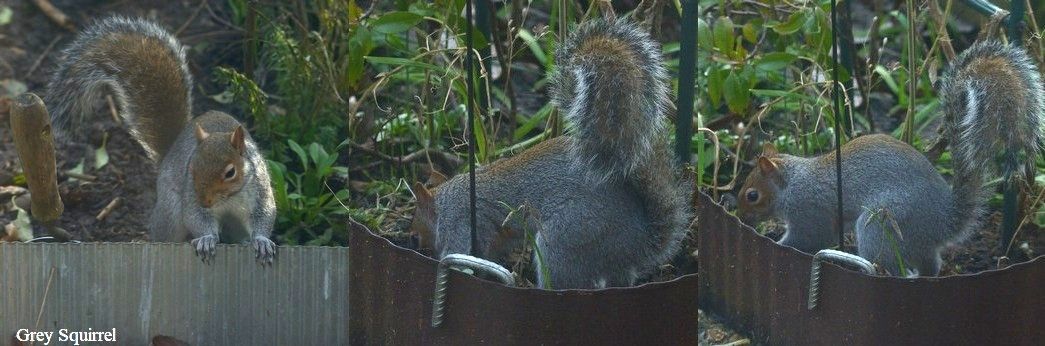
A Grey Squirrel was in and out of the garden, burying items in the garden. I can only presume the items were peanuts, collected from a neighbouring garden. 2 Grear Tit, 2 Blue Tit, 2 Dunnock, Starling, 5 House Sparrow were also garden attendees.
The Grey Squirrel was again present (23rd) in the garden; once again digging and presumably burying items. 2 Dunnock, 2 Blue Tit, 2 Blackbird, Robin and 3 House Sparrows were also present.
3 Blackbird. Dunnock, Starling, Blue Tit, 2 Collared Dove, 10+ House Sparrow were all seen in the garden (24th) as was the Grey Squirrel again.
With rain (sometimes heavy), pretty much all day and strong winds in the morning the weather was far from pleasant for the garden visitors, but 4 Blackbird, 3 Dunnock, 2 Blue Tit, 2 Robin, 6+House Sparrow, Starling and Collared came in to feed on the offerings put out for them.
For some reason today (30th) the garden was highly active with birds coming in and out of the garden all day (from frequent observations from kitchen window) and a very notable number of 25+ House Sparrows were seen. Also, in the garden were: 5 Blackbird, 2 Starling, 2 Blue Tit, Robin, Dunnock and Collared Dove.
Local Geese, Swans and Buntings......
A short trip out this morning (26th) began at Rollesby Broad, where there were very few birds. However, several Tufted Duck, 3 Great Crested Grebe, a drake Goldeneye and some Pink-footed Geese flying over were of note.
On to Repps/Martham to look through the Pink-footed Goose flock, which were still here; some fairly close, but some distant. Still, looking through the flock found 4 White-fronted Geese and a Barnacle Goose, but couldn’t find any Tundra Bean Geese. But a male Stonechat was seen perched behind the pink-foot flock.
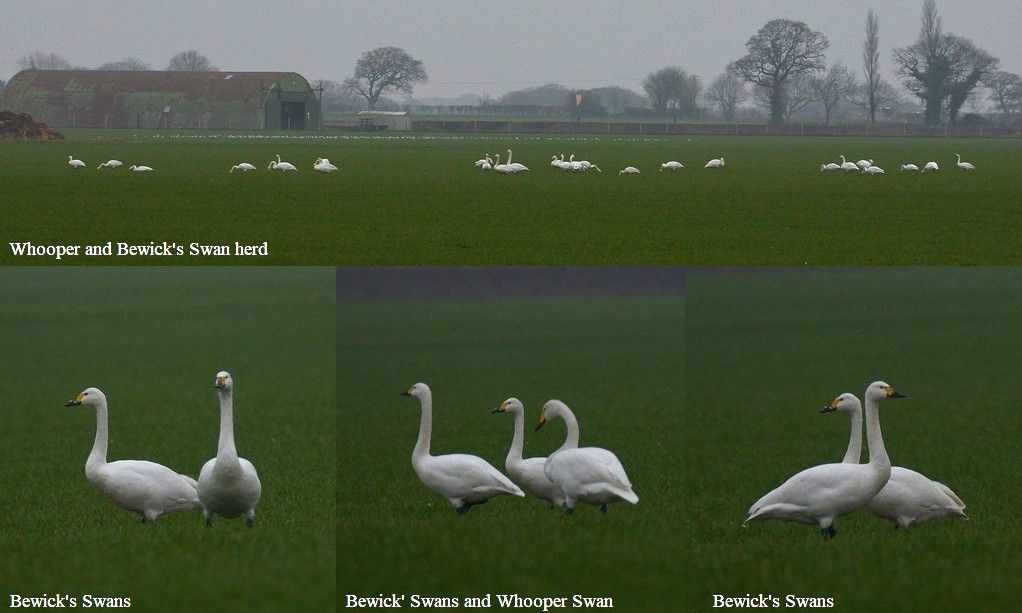
At Ludham Airfield the swan numbers had increased and 41 were present, with at least 11 Bewick’s, amongst the Whooper Swans. A Chinese Water Deer was also present.
Arriving at Winterton Beach Road, I found the car park open and after giving a contribution to the Horsey Seals and a nice chat with the lady with the bucket, I parked up.
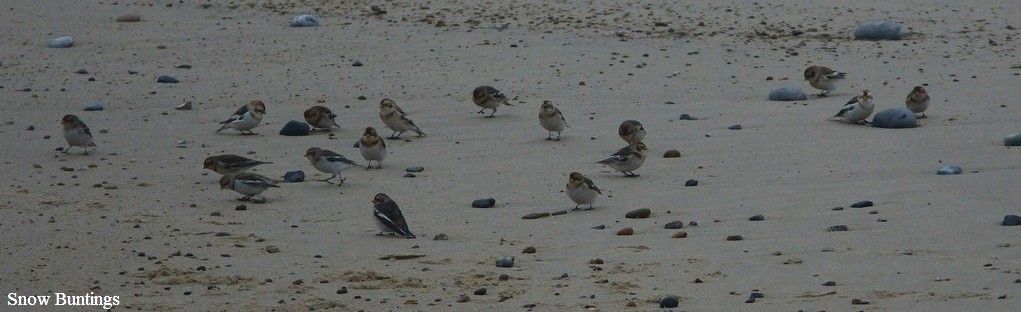
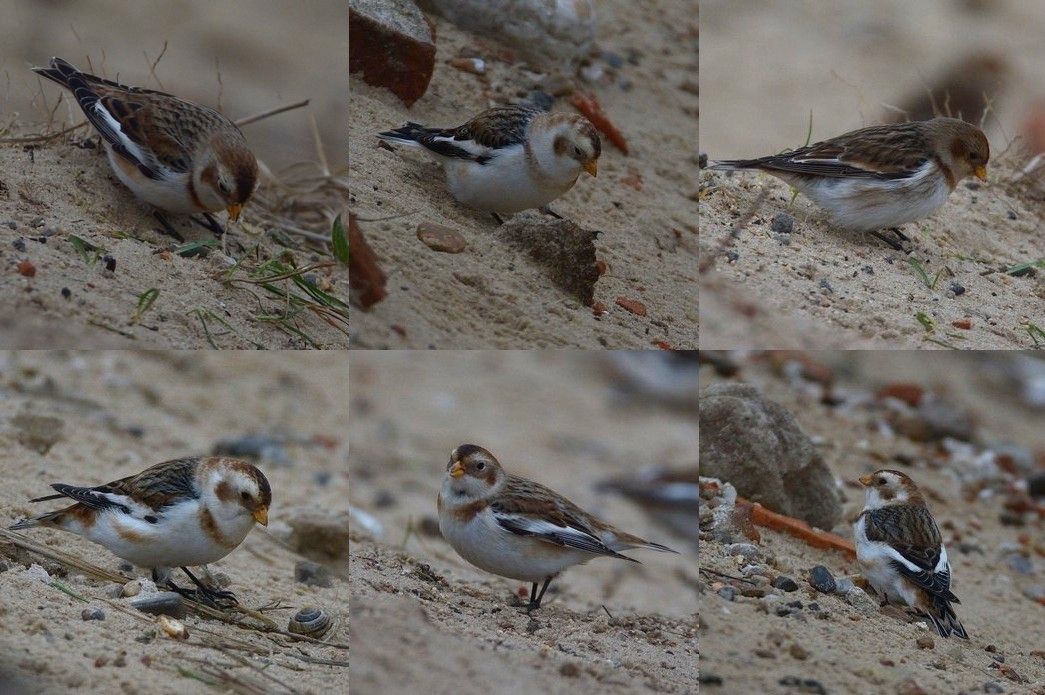
I could see a gentleman with a camera, near to the beach huts, so knew it had to either be a Seal, or the Snow Buntings. It was the Snow Buntings, fairly close-in on a slope at the top of the beach. There were around 20 buntings and although they occasionally flew off onto the beach they kept returning to the slope.
With nothing out at sea and the wind now decidedly icy, in the grey conditions, I returned to the car and headed home.
Local coast and Broads......
A look around the local area (24th) began at Winterton with a look for the reported Snow Bunting flock numbering 70+. However, the car park was closed and a look from the road over the beach found no Snow Buntings or anything else for that matter!
Driving along the coast road found very little, but both a Marsh Harrier and Common Buzzard at Horsey were notable, before coming across a Pink-footed Goose flock (approximately 700) at Sea Palling, in the same place as the 20th. This time I got to scan through them but just Pink-feet here.
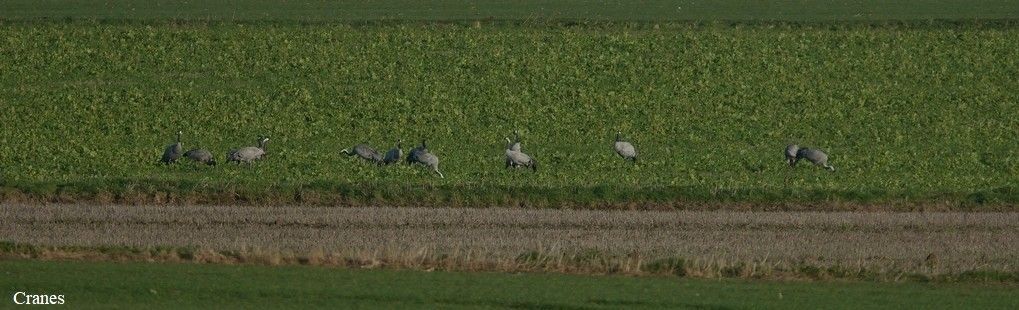
Connecting with the Stalham bypass after travelling through Hickling village, a look across at the fields around Ludham Airfield found no swans so on to the area around Clippesby, where I spotted a Crane flock.
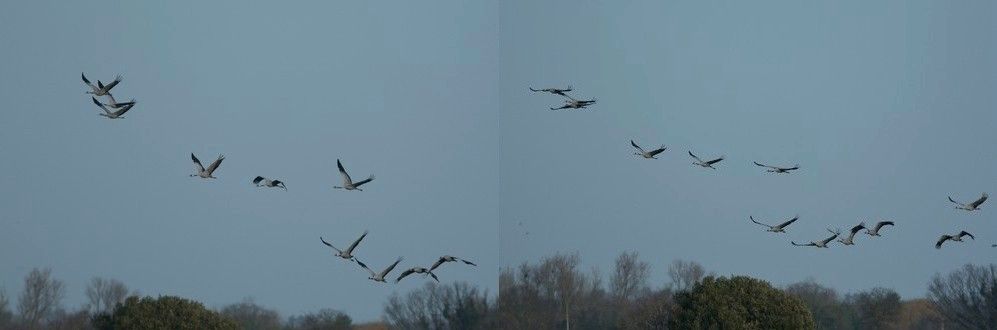
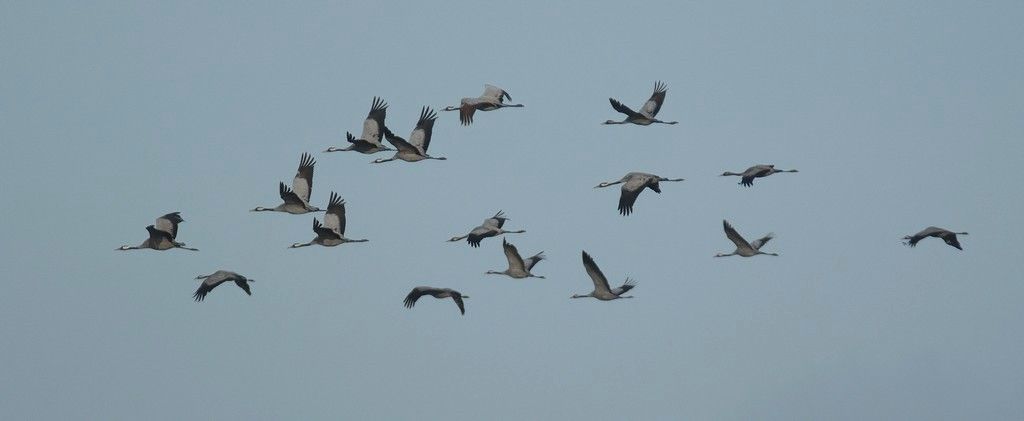
I counted 22 Cranes and there were at least 2 juveniles amongst them. However, someone, presumably from the local farming community decided to wander across the fields near to the Cranes and several of them took flight. A little while later the remaining Cranes took flight, but gave the opportunity for some flight shots. At least 6 Brown Hares were seen here with some chasing going on.
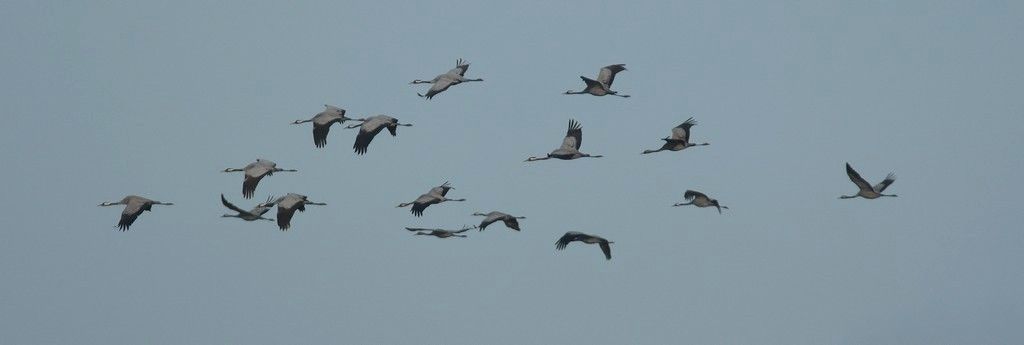
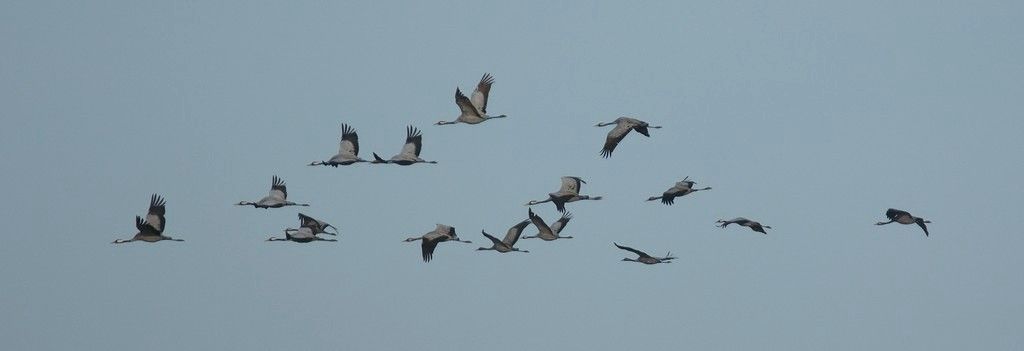
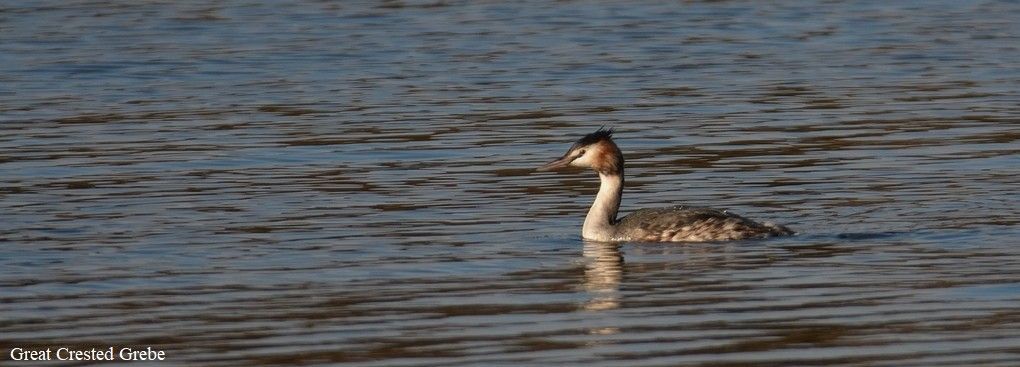
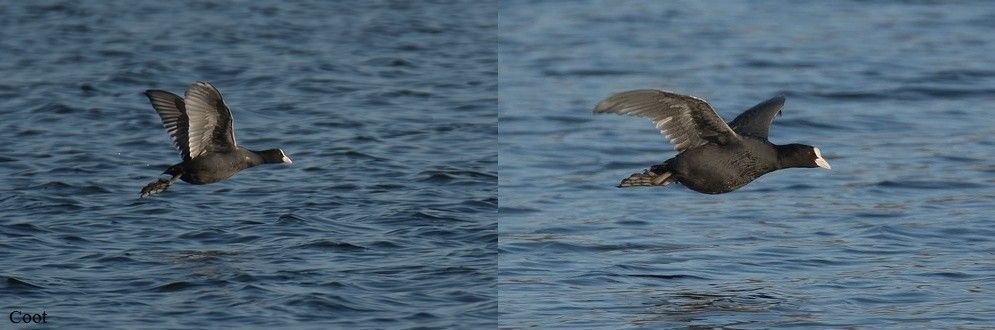
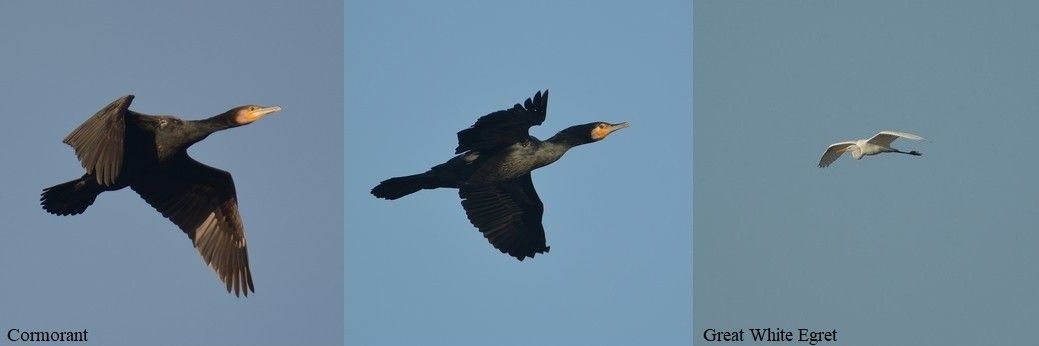
Onwards to Filby and once parked in the car park, I made my way down to Ormesby Little Broad. A drake Goldeneye flew across the broad, after being disturbed by Pike anglers and a few Tufted Duck, at least 6 Great Crested Grebes and plentiful Coot were here. A large white bird only briefly glimpsed at the far end of the broad, was confirmed as a Great White Egret when the anglers reached the spot where it had disappeared from my sight!
Local places......
A drive around the ‘local block’ today in very miserable wet weather began at Ludham Airfield where there were a herd of Whooper and Bewick’s Swans; 32 in total.
I then headed along the coast road and found 42 Canada Geese at West Somerton and a family of Cranes (2 adults, 1 juvenile/immature) at Horsey. A Common Buzzard was perched on top of a telegraph pole at Waxham, before I came across at least 2000 Pink-footed Geese on a field just after the turn-off to Hickling at Sea Palling. However, for some unseen reason the flock turned into a skein, all but a few still on the ground, so no time to scan the flock for other species as they landed out of view further on.
I then met up with Jason Nichols at Ludham Airfield and he said some more swans had flown in and now there were 30 Whooper and 8 Bewick’s Swans.
On the way back to Martham, I stopped off to view a sizeable flock of Pink-footed Geese (below) at Repps on a harvested Sugar Beet field, but again found no other goose species with them.
A drive around the Clippesby area found 2 Common Buzzards, but little else, so home for bacon sandwiches and a cup of tea!
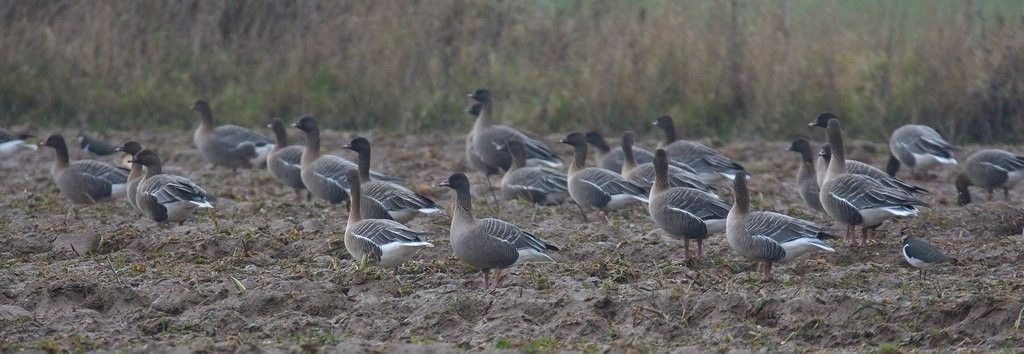
Ducks Cranes, Geese and Swans......
There had been a few ducks of ‘interest’ recently on the Trinity Broads; mainly Filby, so I travelled to Filby (12th).
From the boardwalk I scanned the flocks of duck on the broad; all very far away. However, a gentleman next to me pointed me in the direction of a very distant Ferruginous Duck. I could see the ruddy brown body and white undertail, so a Ferruginous Duck of one degree or another, but with it floating around asleep and the distance made an exact diagnosis impossible.
There were plenty of other duck, with Pochard, Tufted Goldeneye, Shoveler a pair of Gadwall swam past and Mallard but all pretty distant. A Marsh Harrier quartered the reedbed and there were good numbers of Coot on the water and a couple of Great Crested Grebes.
The same gentleman, who pointed out the Ferruginous also pointed out where the duck Ring-necked Duck was too, which was again helpful as my eyes were watering and with the scope being blown about, I was struggling! I managed to find the Ring-necked Duck, behind some Tufted, drifting around asleep and saw enough field marks to identify the duck.
There was no sign of the Redhead Smew or any of the Scaup (not that I could see!), so I left for ‘pastures new’!
I had passed some Geese on the way to Filby; presumably Pink-feet on a field near Clippesby so I headed there to see if I could view them.
As I drove along the road, I couldn’t see any geese but pulling in to ‘layby’ I found the flock of Pink-footed Geese, but couldn’t see any other geese species in their midst. However, I found 33 Cranes together on an adjoining field, all feeding on something, that was to their liking. A great sight to see!
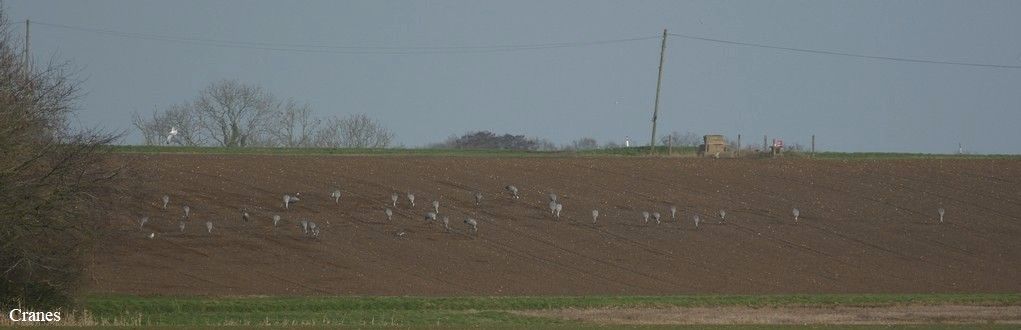
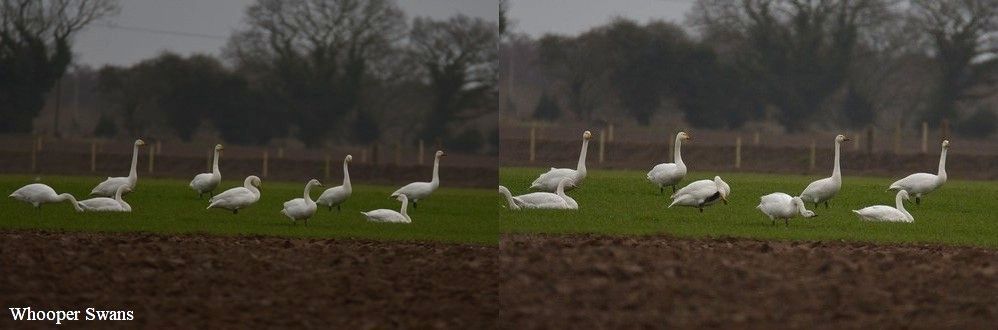
Further on, I saw that there were swans on Ludham Airfield, so I went to have a look and found a herd of 35 ‘wild swans’, with the majority being Whoopers. Also here were a Great Black-backed Gull and 3 Chinese Water Deer.
Swans at Ludham Airfield......
A few items to get from the shops and garage (10th) involved a visit to Ludham Airfield.
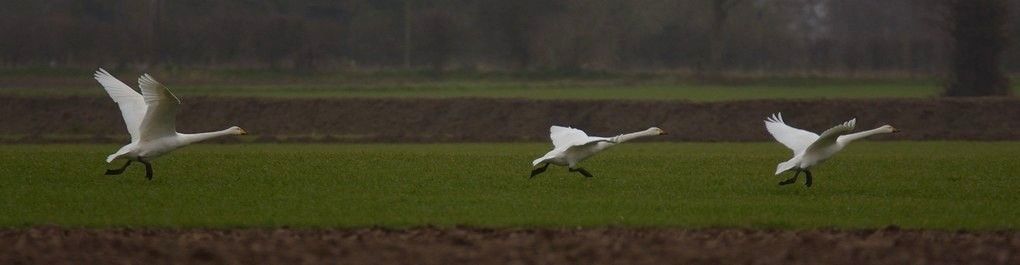
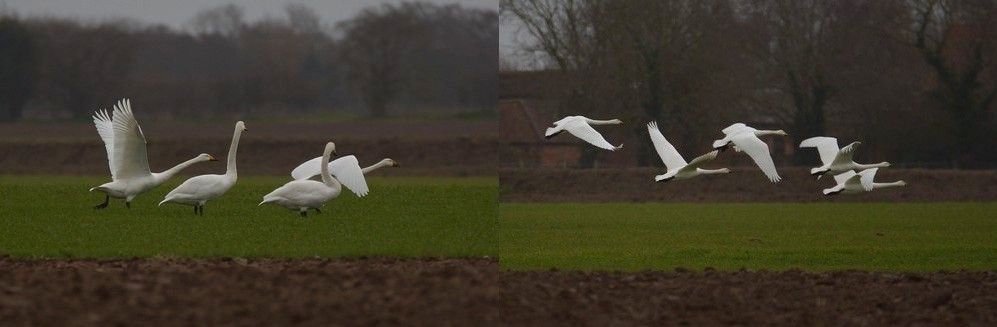
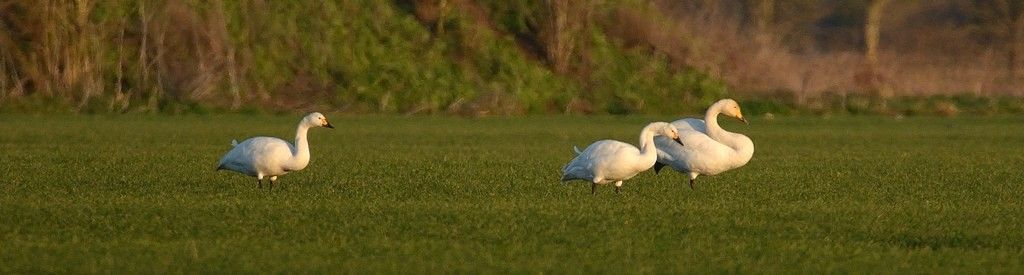
Ludham Airfield had for many years been a place to see wintering Bewick’s and Whooper Swans but so much in recent times’ both in terms of residency or indeed numbers. However, today there were 14 swans present on a Winter Wheat field, just behind the gas depot, with 6 Bewick’s and 8 Whooper Swans.
Also here were a Stock Dove and a Chinese Water Deer.
2 Bewick's with Whooper Swan below.
First week of 2026 in the Garden.....
With the New Year’s Day Wildlife list, from dawn to dusk, nothing for the 1st Jan in the garden was counted.
However, the 2nd saw the following species: 2 Blue Tit, 2 Dunnock, 2 Collared Dove, Wood Pigeon, 9 House Sparrow, Starling and 2 (not for long!) Robins.
The first snowfall of the year (3rd), saw 3 Robins in the garden, along with 2 Dunnock, 2 Blue Tit, 3 Blackbird, 3 Wood Pigeon, 6 Starling. Sev. House Sparrows. 2 Collared Dove and a Wren. Black-headed and Herring Gulls and Jackdaws were seen outside the garden.
With snow still laying and very cold conditions (4th); emphasis was very much on making the sure the birds that come to the garden (and for that matter anywhere!) had everything they needed for them to get through the night, with supplementary food and very important; freshwater.
Today birds recorded were: Blue Tit, 2 Blackbird, 3 Collared Dove, Starling, Robin and several House Sparrows.
A Wren was nice to see (5th) foraging for food in the purposely left dead plants. Also seen were, 4 Blackbird, 3 Blue Tit, 2 Robin, Wood pigeon, 2 Dunnock, approximately 10 House Sparrow, 5 Starling, Great Tit, a daring Black-headed Gull and our first visit of a male Pied Wagtail (which spent approximately three quarters of an hour in garden) and a Long-tailed Tit.
With snow still lying the garden had visitors of: Blue Tit, Great Tit, Robin, 2 Dunnock, 3 Wood Pigeon, 2 Collared Dove, 5-6 Blackbird, sev’ House Sparrow, 5 Starling and 4 Long-tailed Tits.
There was a fairly rapid thaw (7th), but a Goldfinch visited the garden. Yet another species added to our small, but clearly vital space.
New Year's Day; a Norfolk Wildlife count
Just after 5.00 (1st) Jason Nichols arrived to pick me up to go on the ‘traditional’ New Year’s Day wildlife count.
We had decided to begin at Titchwell and work our way back down the coast; hopefully in time to see species in the area of the Broads.
Just before Meales Garden Centre, near Wayford Bridge we saw (Jase didn’t!) our first bird a Barn Owl perched on a street light. We then came across another Barn Owl perched in a tree. As Jase didn’t see that one either we turned around and so he could see it, which he did.
Stopping off at Holkham Park, hoping to hear a Tawny Owl was to no avail (far too windy) but our first mammal of 2026 was seen here; ironically a Rabbit; my favourite animal. In fact, we saw 3. So good to see this maligned mammal, which is actually a keystone species in the UK as well as in its native Iberia.
Before reaching Titchwell car park we saw 3 Muntjac, all on the road verge. Deer and other species come down to the roadside verges to feed on the fresh grass mowed by various councils and this is where road casualties occur. Surely, one of many reasons not to mow the verges?
We arrived in the car park at Titchwell, where it was still dark, but a handful of vehicles were already there, and after not hearing a Tawny Owl at Holkham, we heard one here, not only the usual calls associated with these owls but also a ‘bubbling call’ too.
A Wood Pigeon followed as we began our walk to the beach and on the way along the path we recorded: Coot, Moorhen, Teal, Robin (2 on the path), Shoveler, Curlew, Mallard, Black-headed Gull, Black-tailed Godwit and Redshank all in the dim light.
We got in position on the beach (after I fell off a sand hump-old age) and started to scan the sea and beach with telescopes.
Oystercatcher, Bar-tailed Godwit, Grey Plover, Brent Goose were all seen on the shore, a Cormorant flew past and then Sanderling and Herring Gull were added to the day’s total, now standing at 21.
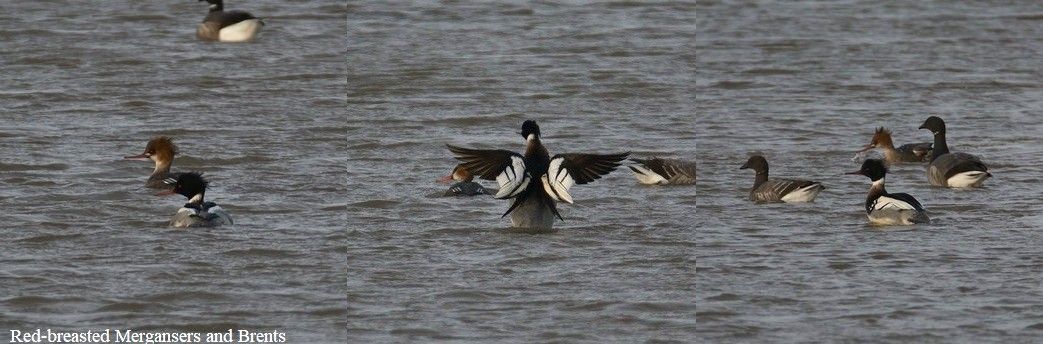
It was pretty tough going in the windy and very cold conditions but I found a drake Goldeneye on the sea. 3 Red-breasted Merganser flew west over the sea and then 3 Long-tailed Ducks were found just beyond the surf. Common Gull, Dunlin, Great Black-backed Gull and Turnstone were then seen.
We began walking back along the path and turned our attentions mainly to the scrapes. Pintail, Wigeon, a flyover Meadow Pipit, Shelduck, Little Egret, Lapwing, a lone Avocet, Starling, Egyptian Goose, Pochard, Tufted Duck, Cetti’s Warbler (heard), Red Kite, Marsh Harrier and a pair of Canada Geese (sometimes a bogey bird for New Year’s Day) were all recorded before we reached the woodland.
The first bird in the trees was a Blue Tit, then Chaffinch, Great Tit, Goldfinch, Long-tailed Tit, Chiffchaff and the 50th bird of the day a Treecreeper, which was a great bird to see!
Some tapping was heard and I finally managed to locate the bird making this sound; a Great Spotted Woodpecker high up in the canopy.
We left Titchwell and headed to Thornham, seeing Collared Dove and Jackdaw en-route.
At Thornham the only new bird of the day was a Magpie, so we headed to Choosley Barns, seeing Carrion Crow, Blackbird and Dunnock on the way.
We began heading up the road to the barns seeing Kestrel, Common Buzzard, Red-legged Partridge, Chinese Water Deer, skeins of Pink-footed Geese (all across the length of the skyline), Rook, Lesser Black-backed Gull and Pied Wagtail.
Next stop was Brancaster Staithe where a Ringed Plover was added to the list, but also here were a pair of Red-breasted Mergansers, plus another female flying up the channel.
A lone Fieldfare flew out of a hedgerow, en-route to Holkham ‘gate where we managed to see White-fronted Geese and a Grey Heron and around 18 Red Deer and a further Muntjac.
From the ‘layby’ further along the road we found 3 Barnacle Geese and a cock Pheasant, before a brief visit to Lady Ann’s Drive where there were many Pink-footed Geese but also a lot of people, so we turned around and continued our journey, back along the coast.
A stop at Morston Quay found very little and the Greenshank we see nearly every time we come here, was inconveniently absent today!
At Cley, along Beach Road, there were at least 1000 Pink-feet on the fields but despite a look off coastguards we found next to nothing, either on the sea or flying over it.
We headed to Natural Surroundings where we heard Nuthatch and saw Coal Tits on the feeders and back to the coast road where a Gadwall on Salthouse duck pond was very welcome, taking our tally to 74.
On to Sheringham, seeing Feral Pigeons on the way, we found somewhere to park and saw House Sparrows in the seafront bushes. Our main reason for being here was the long-staying Eastern Black Redstart, which after a bit of a run around (including a failed look on the Golf Course for a Grey Wagtail) we fount the Redstart in someone’s garden in a bush, before it flew up to a window cill. Hardly picturesque for photos but needs must!
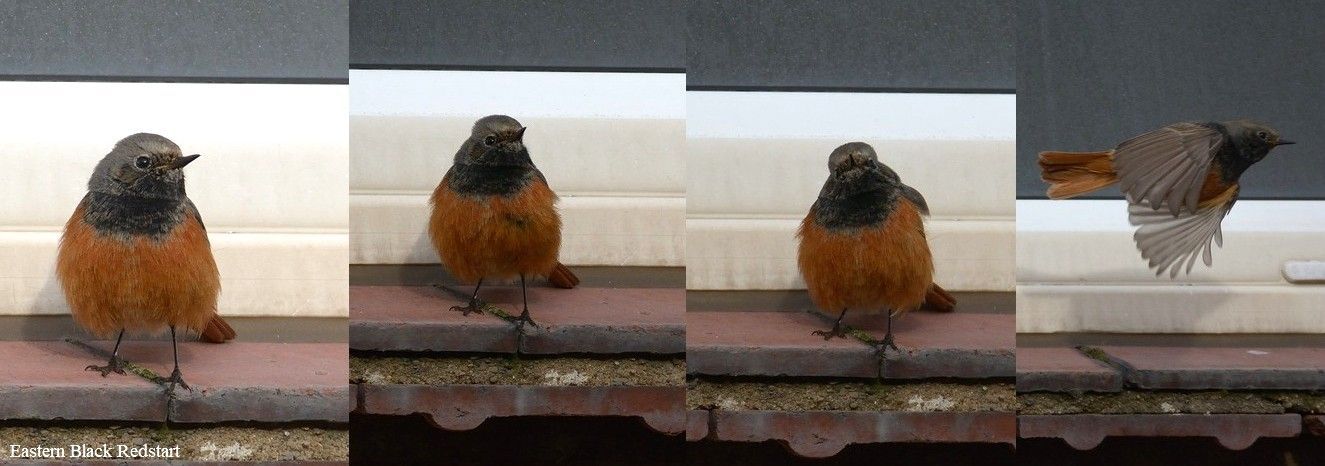
We looked around Ludham Airfield for ‘wild’ Swans but to no avail and found ourselves in Ludham, so we decided to check out the roads leading to St. Benet’s Abbey and to the river.
A Black-winged Kite had been present in the area, so we knew the area around St Benet’s would be busy and indeed it was! However, we found 8 Cattle Egrets here before driving back along the track.
We then headed along the other track, towards the river and this turned out to be worthwhile.
We stopped, as I saw two birds in flight, but never got to identify them as Jase called out a Sandpiper; a Green Sandpiper around the puddles near a manure heap, where unbelievably there was also a Grey Wagtail and several Pied Wagtails, all looking for food. A male Sparrowhawk flew low across the road in front of us before Jase had an elevated look from the river bank but could only see Mute Swans; again, no Bewick’s and Whoopers!
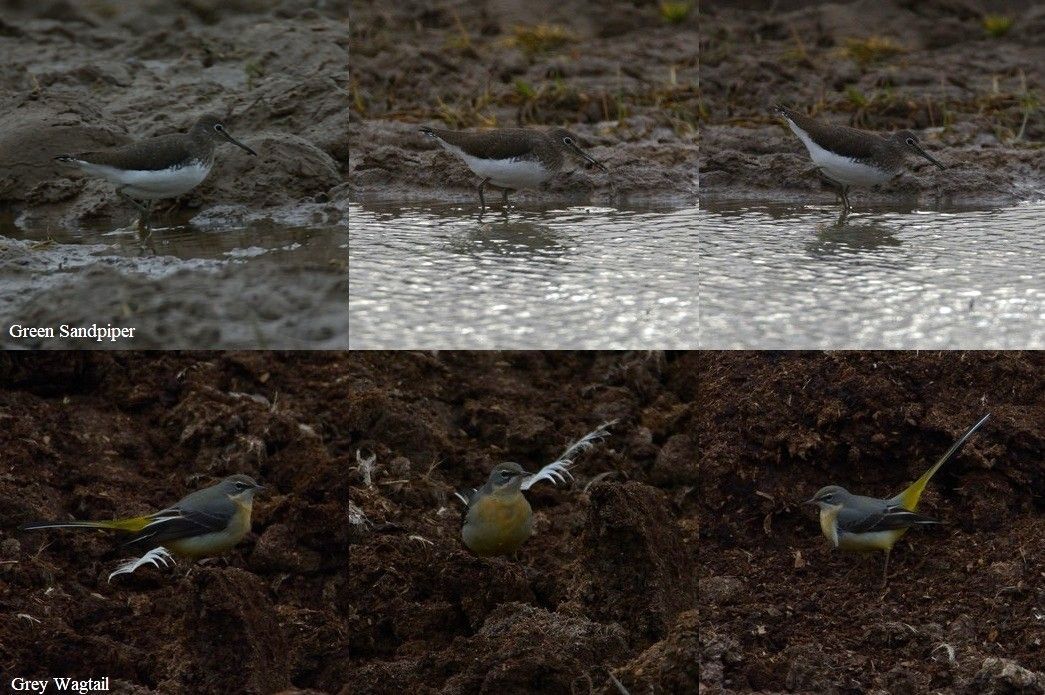
We drove back along the track and headed to Ludham Bridge; another place where the Black-winged Kite had been seen from, but again no ‘wild swans. However, Jason found 4 Cranes in the distance.
Now on 82 avian species for the day (although we did not know this at the time) we headed for Filby.
There had been several of the ‘scarcer’ Ducks here but the vast majority were at the very far side of the broad. I heard a Wren call here, from the boardwalk and a distant Great Crested Grebe, before my main quarry came out from behind the reeds to our left; a splendid drake Eider and 2 ducks. I had never seen this species of duck on the Trinity Broads before, so it was great to finally catch up with the Eiders, which had been here for several days.
We then headed to the coast road, via Hickling and drove along the road north of Sea Palling hoping that the ‘wild swans’ would be here, where we had seen them before. Unfortunately, not!
Back along the coast road we parked in the ‘layby’ at Horsey hoping for some additional species to add to the day list. Unfortunately, there was very little here, apart from Lapwings, a female Sparrowhawk and Marsh Harriers so at around 16.00 we called it a day, but saw a further 5 Cattle Egrets at West Somerton, on the drive back to Marham.
We had managed to see 85 species of birds and 4 species of mammal (5 if you include the workings of Moles!)
What has been noticeable over the years of doing this wildlife count is that seeing species has become more and more difficult to find. Whilst, for Jason and myself, this is a good day out (with some competitive edge!) it shows the decline in many species, if not all; a sad state of affairs in what has become one of the most wildlife-depleted countries in Europe!